Answer Card
Buyer Decision Summary
- Problem
- The difference between genuine OE, OEM-quality aftermarket, and low-end aftermarket is not just price.
- Best control
- Use OE/VIN checks, old-part photos, and pre-shipment confirmation before approving a mixed order.
- Best buyer fit
- Global export buyers parts shops, workshops, distributors, and online sellers
- Brace support
- Jordan checks OE / VIN / old-part photos, confirms stock or source options, and routes mixed-order quotes to WhatsApp.
- Next step
- Send OE / VIN / photo on WhatsApp
What Do These Three Terms Actually Mean?
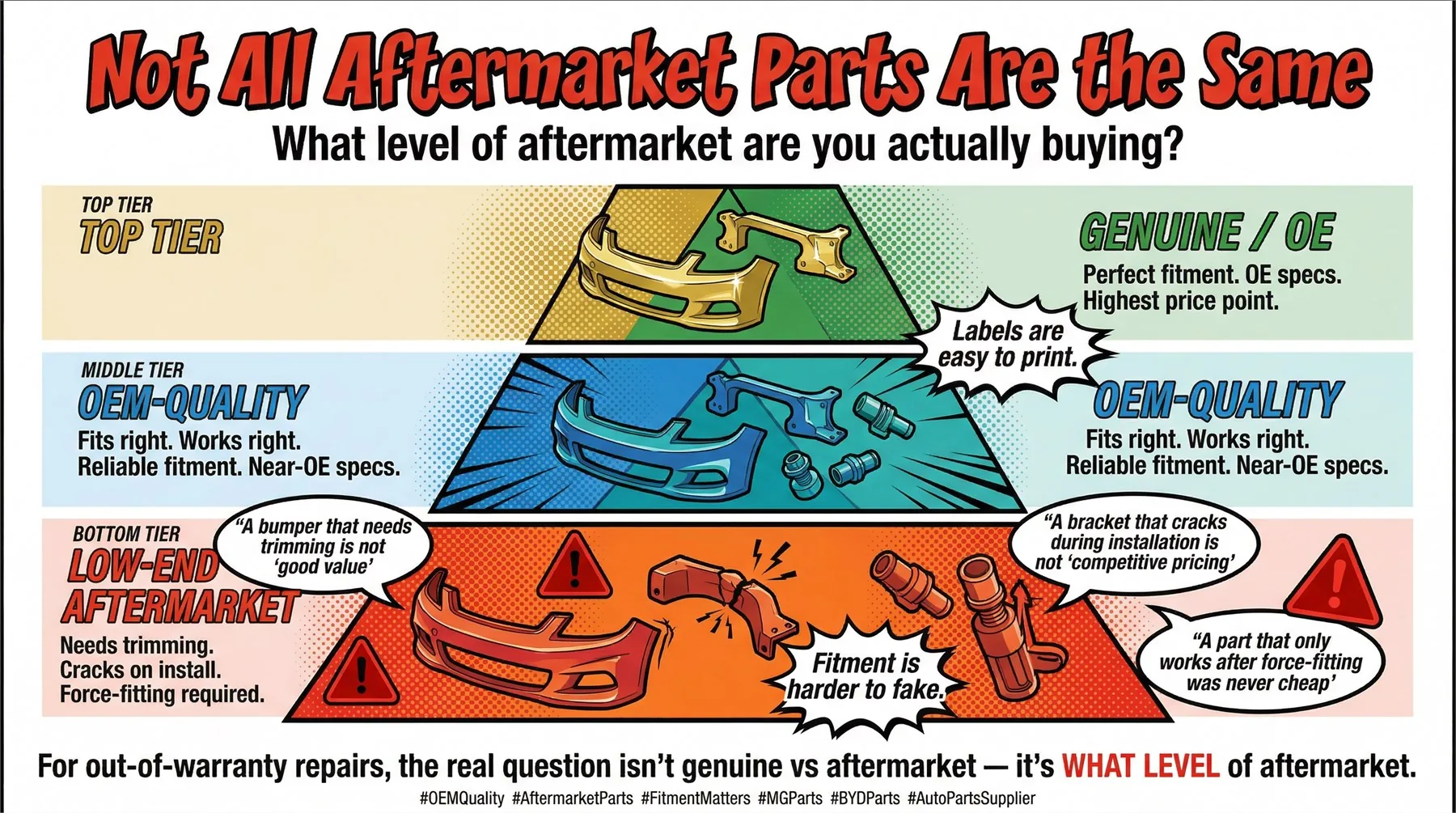
Genuine OE (Original Equipment) means the part is supplied through the vehicle manufacturer’s official parts network, often in branded packaging. It is produced by the same supplier who made the original component for the assembly line, or by an officially licensed alternative. The key attribute is not quality alone — it is supply-chain authenticity and full traceability.
OEM-quality aftermarket means the part is manufactured to meet or closely approximate OE dimensional, material, and performance standards, but it moves through independent channels rather than the vehicle brand’s official network. The manufacturer may be the same factory that produces genuine parts, operating on a parallel production line, or it may be an independent supplier who reverse-engineers to OE specifications. The critical difference is distribution channel, not necessarily manufacturing origin.
Low-end aftermarket refers to parts produced with cost as the primary design constraint. These parts may use thinner materials, simplified tooling, lower-grade plastics, or less precise tolerances. They can function in some applications but often create installation problems, premature failure, or cosmetic mismatch. The risk is not that they are cheap. The risk is that they can multiply total job cost through rework and customer dissatisfaction.
Why Are Labels Not Enough?
Labels are easy to print. That is exactly why they are not enough by themselves. Two parts can both be described as aftermarket and still behave very differently once they reach the workshop. One may install cleanly, align well, and hold finish. Another may need trimming, force fitting, or replacement after the first attempt.
The same problem appears when buyers assume that every low-priced item creates savings. If the part creates rework, labor waste, or customer delay, the cheaper invoice can turn into a more expensive job. In collision repair, a poorly fitting bumper that requires two hours of additional labour can erase a USD 80 parts saving entirely.
What Does Genuine Or OE Usually Mean?
Genuine or OE usually means the part is aligned with original-equipment supply. Buyers often choose it when they want the highest confidence level and are willing to pay more for it. That does not mean it is always the best answer for every repair job, but it does mean the buyer expects the strongest fitment confidence.
Genuine parts typically carry the vehicle brand’s logo and part number, and they are distributed through authorised dealer networks. In warranty repair, genuine is often mandatory. For post-warranty work, the decision becomes economic rather than technical. A workshop repairing a 2018 Toyota Hilux for a fleet customer may not need genuine brake pads when OEM-quality aftermarket pads perform identically at 60% of the cost.
What Is OEM-Quality Aftermarket?
OEM-quality aftermarket is often the most practical middle lane. The part is not presented as official genuine OE, but it is expected to fit correctly, function correctly, and sit close to original standards in the areas that matter to the repair. This is often the value position serious buyers care about most.
The term is not legally regulated, which means suppliers can claim it without proof. Discerning buyers look for specific signals: ISO 9001 or IATF 16949 certification at the manufacturing facility, material specifications that match OE (for example, PP+EPDM bumper covers rather than straight PP), and dimensional tolerances within ±1mm on mounting points. Some OEM-quality suppliers can also provide batch testing data or third-party inspection reports.
For Chinese-brand vehicles — MG, BYD, GWM, Jetour, GAC — the OEM-quality aftermarket is especially important because genuine networks outside China are still expanding. A workshop in Dubai cannot always wait three weeks for a genuine GWM bumper from the dealer. A well-sourced OEM-quality aftermarket unit that arrives in five days may be the only practical option.
What Is Low-End Aftermarket And Why Does It Hurt Jobs?
Low-end aftermarket usually reveals itself through weak consistency. The part may need trimming, show poor alignment, crack under install stress, or create cosmetic mismatch. Buyers often feel the pain in body parts and brackets first, but the real damage happens in labor time and reputation, not just part cost.
Common low-end failures include: plastic parts that warp in Gulf heat within six months, chrome trim that peels after one car wash cycle, rubber seals that harden prematurely, and fasteners that strip during installation because thread tolerances are loose. These are not hypothetical problems. Workshop forums in the Middle East and Australia regularly document specific part lines that consistently underperform.
| Level | Typical Strength | Main Risk | Approximate Price Range vs. Genuine |
|---|---|---|---|
| Genuine / OE | Highest fitment confidence; full traceability | Highest cost; longer lead times in some markets | 100% (baseline) |
| OEM-quality aftermarket | Strong fitment; good material match; reasonable consistency | Variable supplier quality; term is unregulated | 50-75% |
| Low-end aftermarket | Lowest upfront cost | Rework, alignment issues, premature failure, reputation damage | 25-45% |
When Should You Choose Each Level?
The right choice depends on repair type, customer expectation, and warranty status. Here is a practical framework:
| Repair Scenario | Recommended Level | Reasoning |
|---|---|---|
| Warranty repair | Genuine OE | Required by manufacturer; no substitute accepted |
| Insurance collision (premium vehicle) | Genuine OE or OEM-quality | Customer expects factory finish; insurer may mandate OE |
| Insurance collision (fleet/standard vehicle) | OEM-quality aftermarket | Balances cost and quality; accepted by most insurers |
| Routine maintenance (brakes, filters, belts) | OEM-quality aftermarket | Performance standards are well documented; cost saving is real |
| Budget repair / older fleet unit | Low-end aftermarket (selected carefully) | Acceptable when vehicle value is low and failure consequence is minor |
| Cooling system (radiator, condenser) | OEM-quality or genuine | Failure strand vehicle; heat stress in Gulf punishes cheap parts |
Why Chinese-Brand Vehicles Make This Choice Harder
For established Japanese and Korean brands, the aftermarket ecosystem is mature. Buyers know which suppliers produce reliable OEM-quality lines and which ones trade low-end stock. For Chinese brands like MG, BYD, GWM, and Jetour, the aftermarket is still forming. That means:
- Genuine networks outside China may have limited catalog depth.
- OEM-quality aftermarket suppliers may not yet advertise Chinese-brand compatibility prominently.
- Low-end parts may flood the market first because they are easier to produce and ship quickly.
The buyer who can identify genuine OEM-quality suppliers early — before the market is saturated with low-end options — gains a sourcing advantage that compounds over time. The first reliable supplier relationship is worth more than a small unit-price advantage on the first order.
How to Verify What Level You Are Actually Buying
Suppliers can write any label on a box. Buyers who want certainty need to verify, not trust. Here is a six-step verification process:
- Ask for the manufacturing facility name and certification. ISO 9001 is the minimum baseline. IATF 16949 (automotive-specific quality management) is stronger. A supplier who cannot name the factory or provide a certificate is probably handling trader-grade stock.
- Request material specifications. For body parts, ask about plastic grade (PP vs. PP+EPDM vs. ABS). For cooling parts, ask about core material (aluminium alloy grade) and fin density. Specific answers signal knowledge. Vague answers signal trading.
- Check mounting point tolerances. Ask whether the supplier measures and guarantees mounting hole positions within ±1mm of OE. This is where low-end parts fail most visibly.
- Request a sample or photo confirmation. For first-time orders, ask the supplier to photograph the actual part before shipment, including mounting points, part number tags, and surface finish. This catches obvious mismatches before freight is committed.
- Test on a non-critical job first. Never install an unverified part on a high-value or warranty-sensitive repair. Use the first order for a routine job where failure consequence is low.
- Track performance over 90 days. Note installation time, fitment quality, customer feedback, and any return requests. This data becomes your supplier rating system.
The Real Cost Calculator
Buyers who focus only on parts price miss the total job cost. A realistic comparison for a bumper replacement includes parts, labour, paint, and potential rework. Here is how the three levels stack up for a typical midsize SUV bumper job in a Gulf workshop:
| Cost Component | Genuine OE | OEM-Quality Aftermarket | Low-End Aftermarket |
|---|---|---|---|
| Part cost | USD 420 | USD 260 | USD 140 |
| Installation labour (3 hrs @ USD 35/hr) | USD 105 | USD 105 | USD 175 (includes rework) |
| Paint and finish | USD 180 | USD 180 | USD 220 (extra prep for poor surface) |
| Total job cost | USD 705 | USD 545 | USD 535 |
In this example, the low-end part saves only USD 10 on the total job while introducing quality risk. The OEM-quality aftermarket saves USD 160 with acceptable risk. The genuine part costs USD 160 more than OEM-quality for marginal additional confidence. For most post-warranty collision work, OEM-quality aftermarket is the rational choice.
Sources & Methodology
This article is based on industry-standard quality frameworks and publicly available certification standards. ISO 9001 and IATF 16949 are internationally recognised quality management systems for manufacturing. Price ranges are estimated based on public aftermarket catalog data from Australian, Middle Eastern, and Chinese suppliers, and do not represent Brace Auto Parts pricing. Material specifications (PP+EPDM, ABS, aluminium alloy grades) are standard automotive industry classifications. The total job cost example is illustrative and based on typical Gulf workshop labour rates and paint costs. All recommendations reflect the author’s direct experience sourcing auto parts from Chinese manufacturing regions for export to Middle Eastern and Australian markets.
FAQ
Is genuine always the best choice?
Not always. It provides high confidence, but some repairs are better served by strong OEM-quality aftermarket value.
What does OEM-quality really mean?
It usually means the part is expected to fit and function close to OE standards without being presented as official genuine OE.
Why can low-end parts become expensive?
Because trimming, cracking, poor alignment, and rework increase total job cost.
What is the key screening question?
Ask what proof the supplier can give that the part fits right and works right, not just what label is printed on it.
Can I mix levels on the same vehicle?
Yes, but do it strategically. Use genuine for warranty-critical or high-visibility components. Use OEM-quality aftermarket for routine wear items. Avoid low-end on any part where failure would strand the vehicle or create safety risk.
Buyer Downloads
Use This Guide In A Real RFQ
RFQ Template
Copy This RFQ Format
Brand / model:
Year:
OE number:
VIN:
Old part photo:
Quantity:
Destination:
Need photo confirmation before shipment? Yes / No