Using this guide
This is a sourcing checklist, not a current stock or freight quotation. Confirm the vehicle version, SKU availability, freight and destination requirements for your order. External references are listed below.
At a glance
Buyer Decision Summary
- Problem
- If you want to test a Chinese auto parts supplier properly, do not begin with a full price list request.
- Best control
- Start with a controlled trial order, then expand only after quote speed, photos, packing, and arrival checks are proven.
- Best buyer fit
- Global export buyers distributors and first-order buyers
- Brace support
- Jordan checks OE / VIN / old-part photos, confirms stock or source options, and routes mixed-order quotes to WhatsApp.
- Next step
- Send OE / VIN / photo on WhatsApp
What Is Supplier Screening in the Auto Parts Trade?
Supplier screening is the process of evaluating a new parts supplier before committing to a large or long-term order. In the Chinese auto parts export market, screening is critical because the supplier landscape is vast and uneven. Guangzhou alone hosts thousands of broker layers and manufacturing facilities, ranging from ISO-certified factories with direct OE relationships to small traders who source from secondary markets. A buyer who skips structured screening risks receiving wrong-fit parts, inconsistent quality, or stock that exists only in a catalogue, not in a warehouse.
The goal of screening is not to chase the lowest unit quote. It is to find a supplier whose operational quality matches your repair or resale standards. That match is tested through specific part inquiries, not through general price negotiations.
Why Is Asking For A Price List The Wrong First Move?
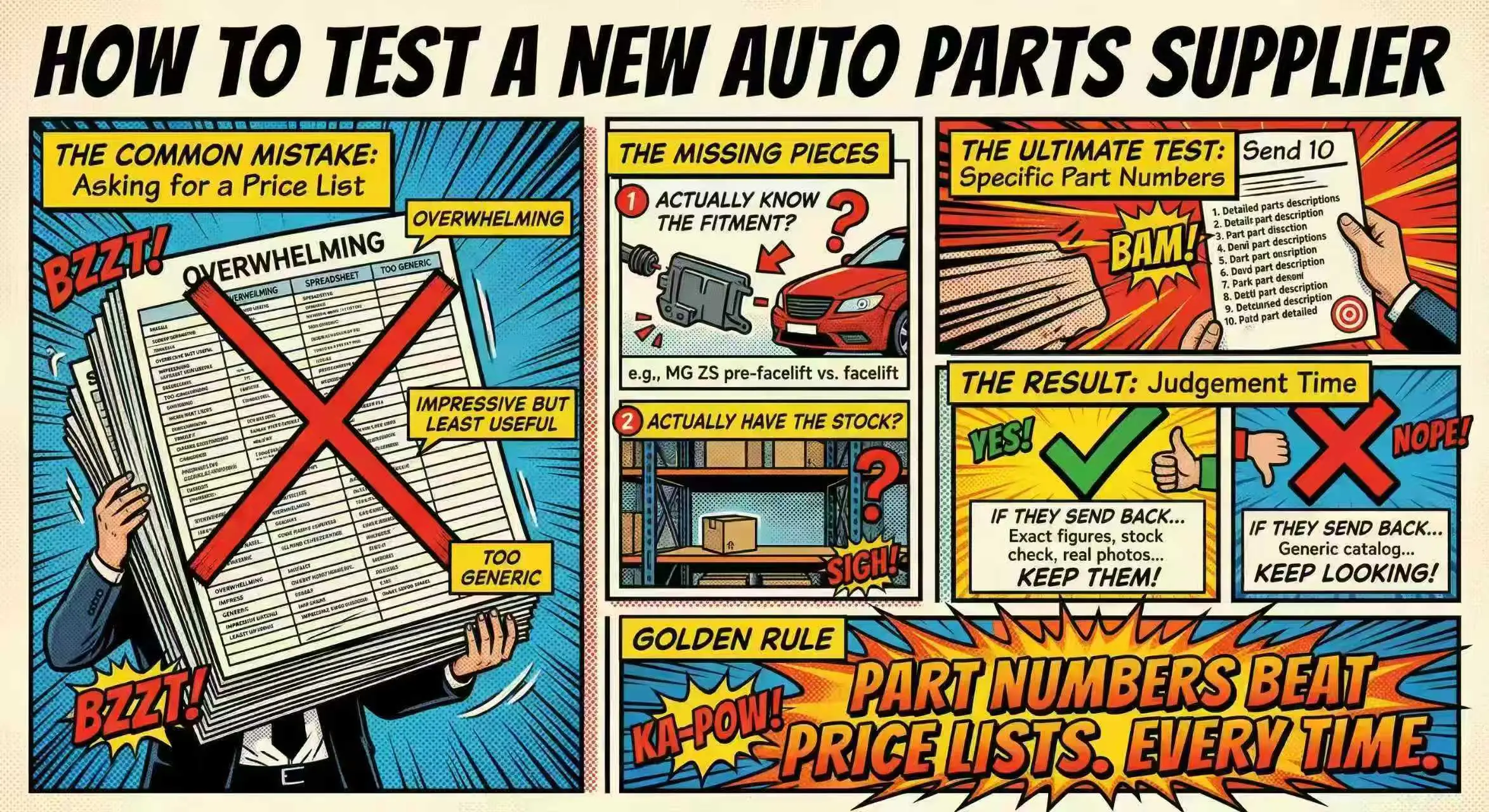
A large spreadsheet feels impressive because it creates the illusion of coverage. It tells you the supplier has many SKUs, many labels, and many rows to show. It does not tell you whether the team behind that spreadsheet can help you when the request becomes real.
Real orders are not abstract. They involve model-year changes, facelift updates, sensor openings, bracket differences, and stock gaps that only become visible when the supplier has to process a detailed inquiry. That is why a giant price list is one of the least useful first tests. A 5,000-row catalogue with no stock depth and no fitment logic is worth less than a 10-item quote that is accurate.
What Should The First Test Look Like Instead?
The better test is a short, controlled inquiry. Send a list of around 10 specific items. Make sure the list includes one collision part, one lamp, one cooling item, and one item where year differences or side differences matter. This turns the supplier's daily operating quality into something you can actually inspect.
For example, you can include a front bumper for one MG ZS year range, a cooling fan for another Chinese brand, and a mirror or headlamp where left or right side matters. The point is not to make the order large. The point is to make it diagnostic. A diagnostic inquiry exposes whether the supplier understands fitment, manages stock honestly, and communicates clearly under detail pressure.
The 8-Step Supplier Screening Process
Here is a structured process that buyers can apply consistently across new supplier contacts. Each step builds on the previous one, and skipping steps increases risk.
- Send a 10-item mixed inquiry. Include collision, lamp, cooling, and year-sensitive parts. Do not reveal that this is a test. Treat it as a normal order request.
- Measure response time and quality. A useful first reply typically arrives within 24-48 hours for ready-stock items and includes fitment questions. A reply that arrives in 2 hours with no clarification is often automated or superficial.
- Check for fitment clarification. A strong supplier will ask about year, trim, side, or sensor configuration. A weak supplier will quote blindly.
- Verify stock status honestly. Ask specifically: "Is this in your warehouse today, or does it require sourcing?" Distinguish ready stock from brokered stock.
- Request part photos or factory evidence. For 2-3 key items, ask the supplier to send images of the actual part, packaging, or warehouse location. Stock photos from a catalogue are not evidence.
- Request certification documentation. Ask for ISO 9001 or IATF 16949 certificates. These do not guarantee part quality, but they signal organisational maturity. A supplier who cannot produce a certificate is almost certainly a trader, not a manufacturer.
- Place a small trial order. Limit the first order to USD 800-1,500 and 8-12 lines. This is enough to test packaging, shipping accuracy, and actual fitment without committing capital.
- Track and document results. Record delivery time, packaging quality, fitment accuracy, and communication responsiveness. Use this data to build an supplier scorecard.
Building Your Supplier Scorecard
After testing several suppliers, you need a systematic way to compare them. A simple scorecard helps prevent emotional decisions and captures data for future reference. Rate each supplier on a 1-5 scale across these dimensions:
| Dimension | What to Measure | Weight |
|---|---|---|
| Fitment Accuracy | Percentage of parts that fit without modification | 30% |
| Quote Quality | Speed, clarity, and fitment questioning in first reply | 20% |
| Stock Honesty | Accuracy of stated lead times vs. actual delivery | 20% |
| Communication | Responsiveness and clarity throughout the order cycle | 15% |
| Problem Resolution | How issues are handled when they occur | 15% |
A supplier scoring above 4.0 on fitment accuracy and quote quality is worth building a relationship with. A supplier scoring below 3.0 on stock honesty should be avoided regardless of price advantage.
What Questions Should A Good Supplier Ask Back?
A useful reply should not begin and end with price. It should begin with clarification. If the supplier asks about year, facelift status, left-hand or right-hand fitment, sensor holes, finish, or exact part photos, that is usually a strong signal. It shows they understand that wrong fitment is more expensive than a slow first reply.
If the reply comes back as a generic catalogue, with no fitment logic and no attempt to narrow the part, that is usually a warning sign. Fast answers are not the same as useful answers. Another warning sign is a supplier who claims "all parts available" without checking. No warehouse stocks every SKU for every Chinese brand.
| Test Signal | Strong Supplier | Weak Supplier |
|---|---|---|
| First response | Clarifies year, fitment, and finish | Sends broad catalogue or one-line price |
| Stock answer | Distinguishes ready stock from sourcing lead time | Uses vague "available" language |
| Proof | Sends real part photos or asks for VIN/photo confirmation | Repeats "correct part" without evidence |
| Quote structure | Separates items clearly with notes | Merges items into unclear lump pricing |
| Certification | Provides ISO 9001 or IATF 16949 on request | Claims certification but cannot produce document |
| Communication | Asks follow-up questions to narrow requirements | Agrees to everything without clarification |
Factory vs. Trader: How to Tell the Difference
Many buyers prefer factory-direct relationships because they expect better pricing and faster problem resolution. But traders can also add value, especially when they consolidate parts from multiple factories into a single shipment. The key is knowing which type you are dealing with.
| Indicator | Factory | Trader |
|---|---|---|
| Product range | Narrow; focused on one category or brand | Broad; claims coverage across many brands |
| Facility photos | Shows production lines, warehouses, testing equipment | Shows office, sample room, or generic stock photos |
| Certification | ISO 9001 or IATF 16949 with facility name matching company name | May show certificates from partner factories |
| MOQ flexibility | Higher; prefers batch production | Lower; can mix small quantities from multiple sources |
| Technical depth | Can explain material specs, tolerances, and tooling | Relies on factory for technical answers |
Neither type is inherently better. A specialised factory is ideal for high-volume, single-category orders. A well-managed trader is often better for mixed-brand, small-lot shipments. The screening process reveals which type you are dealing with and whether their strengths match your needs.
Why Do Specific Part Numbers Beat Price Lists Every Time?
Specific part numbers force accountability. They prevent both sides from hiding behind broad descriptions such as "MG bumper" or "fan assembly for BYD." Once the request becomes specific, the supplier must either demonstrate part-level understanding or expose the lack of it.
This is also where mixed orders become useful. Many suppliers look organized on standard bulk items, but lose accuracy when the order reflects real workshop demand. A small mixed batch is a better screening tool than a large generic RFQ. A supplier who handles 10 mixed lines well will probably handle 100 lines well. A supplier who fails on 10 lines will certainly fail on 100.
Common Screening Mistakes Buyers Make
Even experienced buyers fall into predictable traps when evaluating new suppliers:
- Testing only on price. The lowest quote often comes from the supplier who least understands the requirement. Price divergence on the first inquiry usually signals fitment risk, not cost efficiency.
- Ignoring communication quality. A supplier who replies slowly or vaguely before the order will not improve after payment. Pre-sale communication predicts post-sale support.
- Skipping the trial order. Some buyers place large first orders to "lock in" pricing. This is backwards. Large orders should come after small orders have proven accuracy.
- Not documenting results. Without a scorecard, buyers forget which supplier failed on which part type and repeat the same mistake six months later.
Sources & Methodology
This article is based on industry-standard supplier quality frameworks and publicly available certification standards. ISO 9001 and IATF 16949 are internationally recognised quality management systems for automotive manufacturing. The 10-item mixed inquiry method and 8-step screening process are adapted from purchasing best practices in the Chinese auto parts export sector. Price ranges for trial orders (USD 800-1,500) are based on common first-order patterns for small-to-medium workshop buyers in the Middle East and Australia. All recommendations reflect the author's direct experience sourcing and vetting auto parts suppliers in Guangzhou and surrounding manufacturing regions.
FAQ
Should I ask for a full catalogue first?
No. A catalogue can show range, but it does not prove fitment control or mixed-order execution.
How many items should I send in the first test?
Around 10 is practical. It is enough to reveal quality without turning the first check into a large project.
What part types work best for screening?
One collision part, one lamp, one cooling item, and one year-sensitive part work well because they expose real fitment logic.
What is the clearest red flag?
A vague price list without proof, stock detail, or fitment notes usually means weak operational support.
Is a factory always better than a trader?
Not necessarily. Factories excel at volume and single-category depth. Traders excel at mixed-lot consolidation and lower MOQs. Match the supplier type to your order pattern.
Buyer Downloads
Use This Guide In A Real RFQ
RFQ Template
Copy This RFQ Format
Brand / model:
Year:
OE number:
VIN:
Old part photo:
Quantity:
Destination:
Need photo confirmation before shipment? Yes / No