Fact Gate
Review Dates For Time-Sensitive Claims
- Reviewed on
- 2026-05-05, against the public references named in this article where external facts are used.
- Next review due
- 2026-05-31, or sooner if freight, tariff, market availability or public-source conditions change.
- Maintenance rule
- Update or remove time-sensitive wording before reuse if the linked sources no longer support it.
Answer Card
Buyer Decision Summary
- Problem
- Photo confirmation matters because it helps buyers verify the exact part before shipment, especially on bumpers, mirrors, grilles, and headlamps.
- Best control
- Ask for actual-part photos, label photos, mounting-side photos, and packing photos before release.
- Best buyer fit
- Global export buyers parts shops, workshops, distributors, and online sellers
- Brace support
- Jordan checks OE / VIN / old-part photos, confirms stock or source options, and routes mixed-order quotes to WhatsApp.
- Next step
- Send OE / VIN / photo on WhatsApp
What Is Photo Confirmation in Auto Parts Supply?
Photo confirmation is the practice of photographing the actual physical part before shipment and sharing those images with the buyer for verification. Unlike catalogue photos or manufacturer renders, photo confirmation shows the specific unit that will be packed and shipped. It captures visual details such as mounting brackets, connector types, finish quality, and labelling that text descriptions alone cannot reliably convey.
In the Chinese auto parts export trade, photo confirmation has become a standard risk-mitigation tool for buyers who cannot visit suppliers in person. For a buyer in Dubai ordering parts from Guangzhou, a clear pre-shipment image is often the only way to verify fitment before committing to international freight. The cost of this verification step is negligible compared to the cost of receiving and returning a wrong part.
Why Are Certain Parts High-Risk Without Photos?
Some items are visually similar in catalogues but operationally very different in real life. Headlamps can vary by side, trim, and inner bracket. Mirrors can differ by camera provision, fold function, and market side. Bumpers and grilles can change with facelift updates even when the vehicle name stays the same.
The Chinese automotive market moves fast. A model that launched in 2020 may have had three distinct iterations by 2025, each with subtle but critical differences in body parts. Suppliers who rely on memory or generic part numbers can easily pick the wrong version. A photo check forces a visual match against the buyer's requirement before the error becomes expensive.
The Four Most Common Photo Confirmation Traps
Through years of sourcing and shipping, we have identified four categories of error that photo confirmation catches most reliably:
| Error Type | Why It Happens | Photo Check Solution |
|---|---|---|
| Wrong year / facelift | Model names stay the same; body lines change | Photograph side profile and mounting points against reference |
| Wrong side (LH/RH) | Warehouse picker reads label wrong; labels can be ambiguous | Photograph the part from the perspective that shows mounting orientation |
| Bracket / sensor hole mismatch | Trim levels vary; some parts have mounting holes others lack | Photograph the rear/inside surface showing all attachment points |
| Finish or colour variance | Primed vs. textured vs. painted; shade differences | Photograph under neutral lighting with colour reference if needed |
What Does A Good Photo Confirmation Include?
A useful photo check is not one blurry image from a distance. It should show the actual item, the label, the mounting side, the finish, and any visible detail that matters to the job. For lamps, that can mean the rear shell and tabs. For mirrors, it can mean the connector or cover state. For bumper-related parts, it can mean sensor holes or bracket shape.
The goal is not to create extra friction. The goal is to remove costly uncertainty before freight begins. A complete photo confirmation set typically includes: (1) the part label or part number tag, (2) the mounting surface showing brackets and holes, (3) the finished surface from the angle of installation, and (4) any electrical connectors or fittings.
The 6-Step Photo Confirmation Process
Here is how a systematic photo confirmation workflow operates:
- Identify high-risk items. Flag bumpers, lamps, mirrors, grilles, and any part where year or trim variation exists. Low-risk items like filters or belts may not need photo checks.
- Prepare the part in staging area. Remove from shelf, clean visible surfaces, and position with good lighting. Poor lighting hides defects.
- Capture four standard angles. Label view, mounting surface view, finished face view, and detail view of any connectors or unique features.
- Compare against buyer requirements. Check year range, side, trim level, and any specific notes from the original inquiry.
- Send images with brief confirmation note. "Left headlamp for 2022 MG ZS Excite trim, with camera provision, photographed and ready for packing." Clear language reduces confusion.
- Await buyer approval before sealing carton. This pause prevents the most expensive mistake: shipping the wrong part internationally.
Why Is The Cost Of Skipping It Higher Than It Looks?
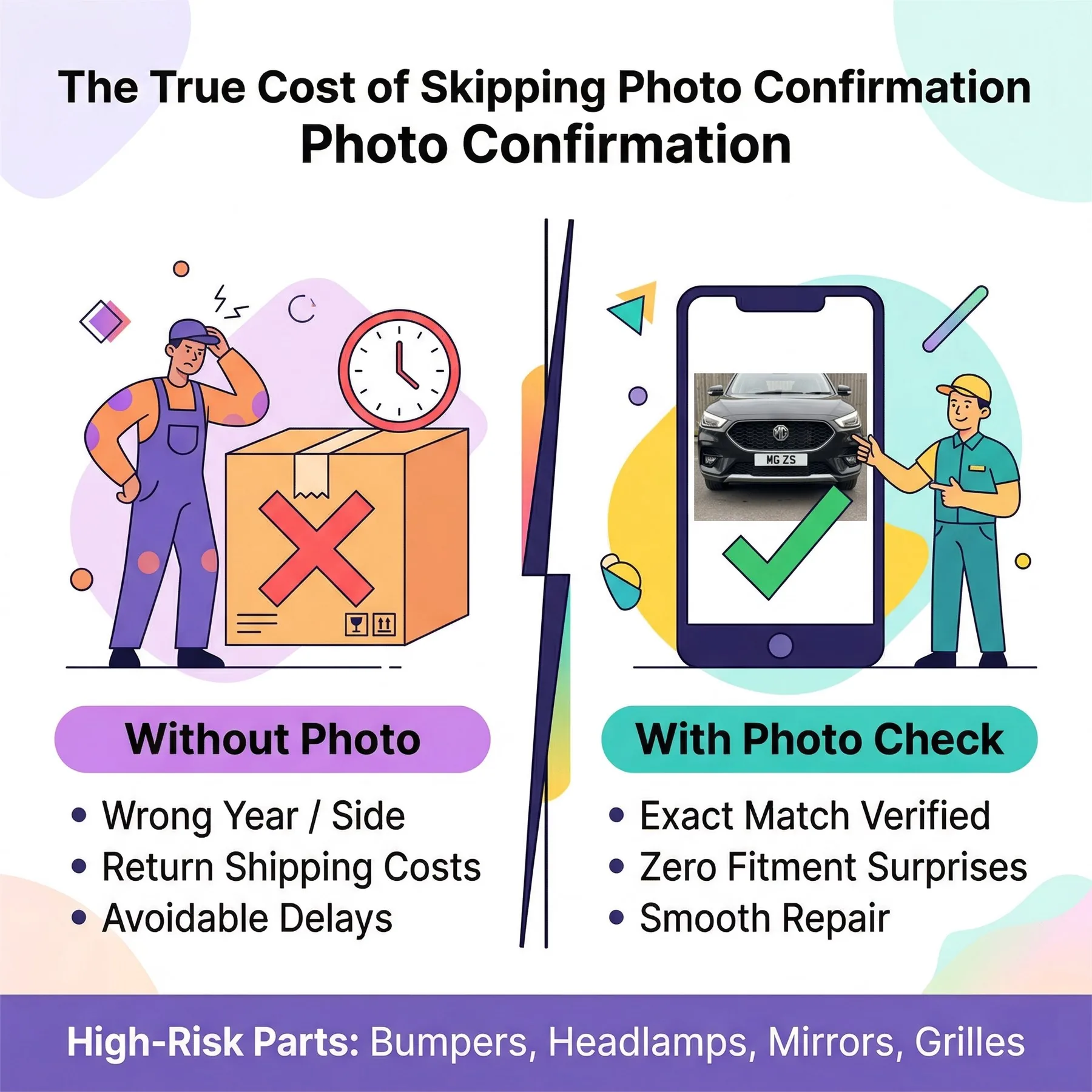
Buyers often compare photo confirmation to speed and assume it slows the order down. In practice, it usually saves time because it avoids the much bigger delay that comes after a wrong part lands. Return freight, replacement coordination, customer updates, and lost repair time are far more expensive than one extra verification step.
| Cost Factor | Without Photo Check | With Photo Check |
|---|---|---|
| Wrong part rate | 5-15% for high-risk items | Under 2% with systematic verification |
| Return freight (China to GCC) | USD 80-150 per carton | Avoided through pre-shipment catch |
| Replacement part cost | Double part cost plus restocking fees | Original part cost only |
| Repair delay | 2-4 weeks for replacement cycle | Original delivery schedule maintained |
| Customer satisfaction | Workshop loses credibility; vehicle stranded | Job completes on time as quoted |
| Total risk exposure per wrong part | USD 200-500 plus reputation damage | Cost of 10 minutes photographing |
Which Buyers Benefit The Most?
Workshops that run tight schedules benefit immediately because photo confirmation protects their timing. Importers who manage mixed orders from multiple brands benefit because it reduces the complexity of verifying fitment across catalogues. And repair businesses that promise exact-fit parts to end customers benefit because it lowers the risk of customer-facing mistakes.
Export buyers in the Middle East, Australia, and Africa benefit disproportionately. International freight from China to these regions typically takes 15-30 days by sea. A wrong part that arrives after this journey creates a delay that cannot be fixed quickly. The replacement cycle becomes 30-60 days. For a workshop with a customer waiting, this is unacceptable. Photo confirmation compresses the error detection window from weeks to hours.
When Is Photo Confirmation Less Critical?
Not every part needs photo verification. Routine maintenance items like oil filters, brake pads, and drive belts rarely have fitment ambiguity. Their specifications are standardised and cross-referenced in catalogues. The risk of a wrong-year oil filter is near zero. The risk of a wrong-year bumper is significant.
Buyers should reserve photo confirmation for: (1) body parts with year or facelift variation, (2) lamps and mirrors with side-specific or trim-specific differences, (3) grilles and bumper covers with sensor or camera provisions, (4) any first-time order from a new supplier, and (5) any order where the supplier has flagged potential ambiguity. This focused approach keeps the process efficient without adding unnecessary delay to simple orders.
Technical Standards for Effective Photos
Not all photos are equally useful. Blurry images, poor lighting, or distant shots can obscure the very details that matter. Here are practical standards for photos that actually reduce risk:
- Resolution: Minimum 1024x768 pixels; 1920x1080 preferred. Phone cameras are adequate if held steady.
- Lighting: Neutral daylight or LED lighting. Avoid yellow warehouse lighting that distorts colour perception.
- Focus: Sharp on mounting points and labels. Blur on cosmetic surfaces is acceptable; blur on brackets is not.
- File naming: Include part number and view angle in filename, e.g., "ZS-2022-LH-Headlamp-Rear-View.jpg"
- Compression: JPEG at 80-90% quality balances file size and clarity. Typical image size 200-500KB is upload-friendly.
Suppliers who take photo confirmation seriously invest in consistent lighting and staging areas. Buyers should expect and request this standard.
How to Request Photo Confirmation from Your Supplier
Many buyers feel awkward asking for photos, worrying it signals distrust. In practice, professional suppliers expect and welcome clear photo requirements because it protects them from returns too. Here is how to make the request effectively:
- State the requirement upfront. Include "photo confirmation required" in your initial RFQ or order note. Do not wait until after the order is placed.
- Specify which items need photos. Not every line needs verification. Flag high-risk items explicitly: "Please confirm photos for line items 3, 7, and 9 (bumpers and headlamps)."
- Define the photo set. Request: (a) part label/tags, (b) mounting surface/rear view, (c) finished face view, (d) connector or detail view. This prevents receiving one useless snapshot.
- Set a reasonable timeframe. "Please send photos within 24 hours so we can approve shipment this week." Creates urgency without being unreasonable.
- Have a backup plan. If a supplier consistently refuses or delivers poor photos, add that supplier to your "photo mandatory" list or consider alternatives. This is a competence signal.
Digital Tools for Managing Photo Confirmation
For buyers managing multiple suppliers or large orders, photo confirmation can be systematised. Several approaches work:
| Tool Type | Examples | Best For |
|---|---|---|
| Messaging apps | WhatsApp, WeChat | Small orders; quick back-and-forth; supplier relationships |
| Shared drives | Google Drive, Dropbox links | Multiple images; batch orders; archived records |
| Purchasing platforms | Alibaba Trade Assurance | Dispute protection; formal documentation; escrow |
| Custom portals | Supplier extranets, ERP modules | High-volume buyers; automated workflows; SKU-level tracking |
The key principle is that photos should be linked to specific order lines and retrievable later. A photo sent via WhatsApp and lost in chat history is only slightly better than no photo at all. Develop a filing habit: supplier name → order date → SKU → photo set.
Sources & Methodology
This article is based on operational practices in the Chinese auto parts export industry and publicly available freight cost data. Return freight costs (USD 80-150 per carton) are estimated from standard air freight rates between Guangzhou and GCC ports. Wrong-part rate estimates (5-15% without verification, under 2% with) are derived from industry discussions and reflect typical experience for body parts sourced from broker layers. International sea freight timing (15-30 days China to Middle East/Australia) is based on standard shipping schedules. All recommendations reflect the author's direct experience managing photo confirmation workflows for auto parts exports from China to markets in the Middle East, Australia, and Africa.
FAQ
Which parts most need photo confirmation?
Bumpers, mirrors, grilles, and headlamps are among the highest-risk items because visual differences often affect fitment.
Does photo confirmation slow down dispatch?
It may add a short check, but it usually saves far more time than a wrong-part correction later.
Can labels alone solve the problem?
No. Labels help, but photos add another layer of confidence when fitment risk is high.
Why is this important for export buyers?
Because international freight makes rework slower, more expensive, and more disruptive.
How many photos are enough?
Four angles typically suffice: label, mounting surface, finished face, and detail view of connectors or unique features.
Buyer Downloads
Use This Guide In A Real RFQ
RFQ Template
Copy This RFQ Format
Brand / model:
Year:
OE number:
VIN:
Old part photo:
Quantity:
Destination:
Need photo confirmation before shipment? Yes / No