Answer Card
Buyer Decision Summary
- Problem
- Model-only sourcing can still create wrong-part, wrong-year, or wrong-version risk.
- Best control
- Confirm OE number, VIN, build year, side, connector, and old-part photos before quote.
- Best buyer fit
- GCC / Middle East workshops and parts shops
- Brace support
- Jordan checks OE / VIN / old-part photos, confirms stock or source options, and routes mixed-order quotes to WhatsApp.
- Next step
- Send OE / VIN / photo on WhatsApp
Quick takeaway
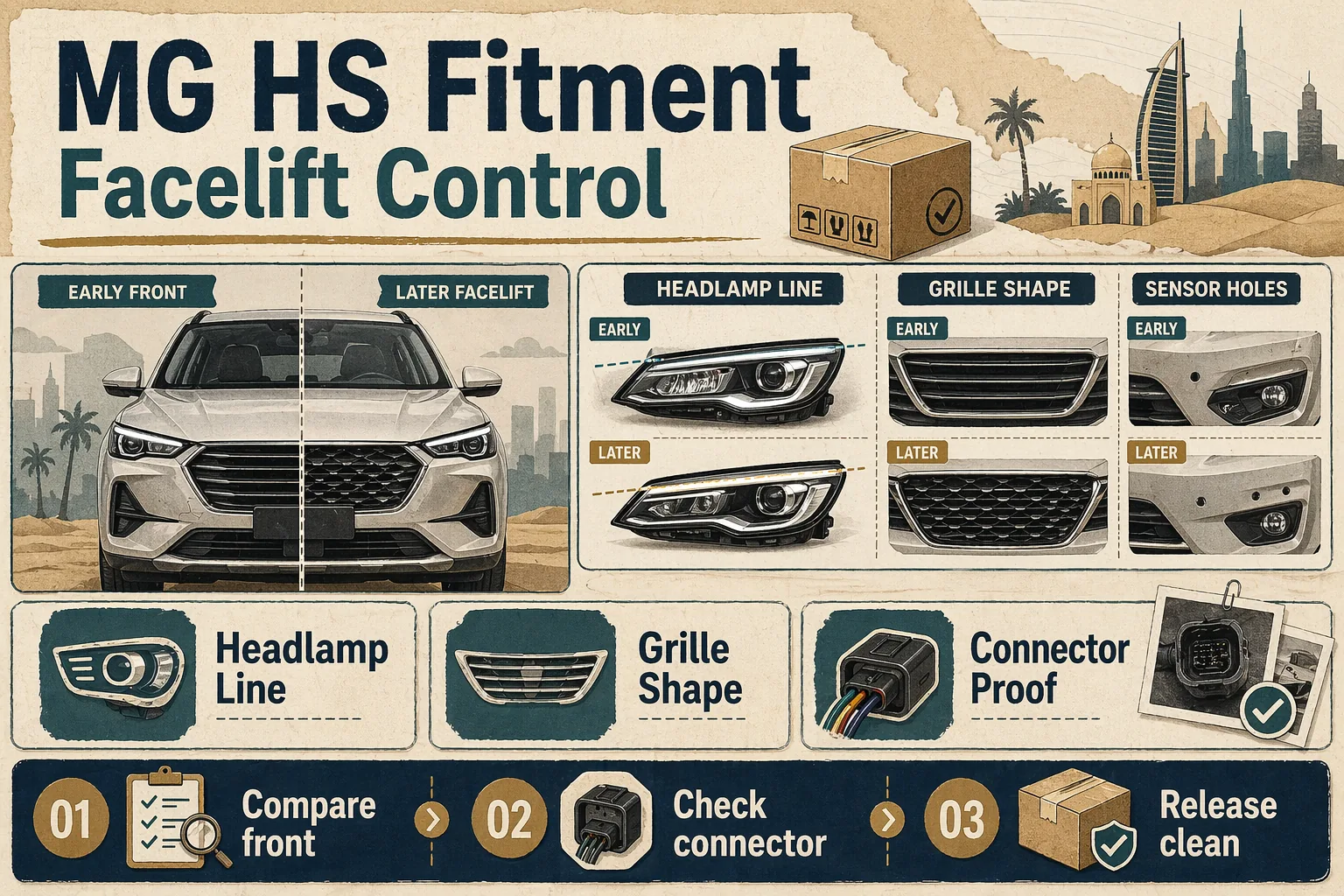
For visible MG HS lines, release quality improves when evidence comes first and price comes second. Keep service and confirmed cooling lines close for daily flow, but hold visual-risk lines under photo-backed confirmation until the exact version is verified.
Benchmark note: The 8-photo release pack is a Brace workflow method used in Brace Auto Parts export handling. It is a practical control tool, not a substitute for buyer-side technical judgment.
What is a facelift fitment trap in workshop terms?
A facelift fitment trap happens when two vehicles share the MG HS commercial name but differ enough in lamps, fascia geometry, brackets, sensors, or trim details to cause installation failure.
Why does this risk remain high even when parts look similar in photos?
Small geometric differences create real fitting problems. Connector orientation, bracket angle, side contour, and sensor-hole placement can all be slightly off while the loose part still looks close enough in a catalog image.
Which MG HS part groups need the strongest control?
| Part group | Release stance | Required proof | Main risk |
|---|---|---|---|
| Service and wear | Local when repeatable | VIN/engine confirmation | Low shelf risk |
| Cooling | Local after repeat proof | Mount/package confirmation | Heat comeback risk |
| Lamps and front fascia | Confirm-before-release | Front view + connector + bracket | Facelift mismatch |
| Mirrors, trim, large panels | Job-based first | Side/finish/old-part photos | Cosmetic + carton risk |
How should workshops run the first 90-day MG HS test?
- Split pre-facelift and facelift units before quoting.
- Collect the full 8-photo pack for each visible-risk line.
- Use old-part label photos whenever available.
- Quote service/cooling lines separately from visual lines.
- Keep bulky panels job-based until repeat accident demand appears.
- Review fitment errors at day 90 and tighten release criteria where needed.
What should buyers measure in the first 30 days?
| Metric | Sign the process is working | Sign to pause |
|---|---|---|
| Version control | Facelift status confirmed before quote | Model-name-only release |
| Proof quality | 8-photo pack complete on risky lines | Generic image-only quoting |
| Stock split clarity | Ready vs sourcing clearly separated | "Everything available" replies |
| Dispatch quality | Packing/shortage status pre-shipment | Issues reported after shipment |
| Claims response | First ownership within 48h | No clear path after 72h |
Common questions
Can MG HS visible parts be matched by model name alone?
No. For lamps, bumpers, mirrors, and trim, model name is only a starting point.
Which lines are safer for early local stock?
Service, small wear, and proven cooling lines.
Why is the 8-photo pack necessary?
It gives enough evidence to verify geometry, side, connectors, and mounting details before packing.
Should large panels be stocked in phase one?
Usually no. Keep them job-based until repeat demand is clear.
Is one clean first order enough to scale?
Usually not. Confirm consistency on at least one follow-up cycle.
Operational verdict
MG HS can be a strong UAE workshop line when release is facelift-controlled and evidence-led. Scale from repeat proof, not from first-order confidence.
Public references
Buyer Downloads
Use This Guide In A Real RFQ
RFQ Template
Copy This RFQ Format
Brand / model:
Year:
OE number:
VIN:
Old part photo:
Quantity:
Destination:
Need photo confirmation before shipment? Yes / No