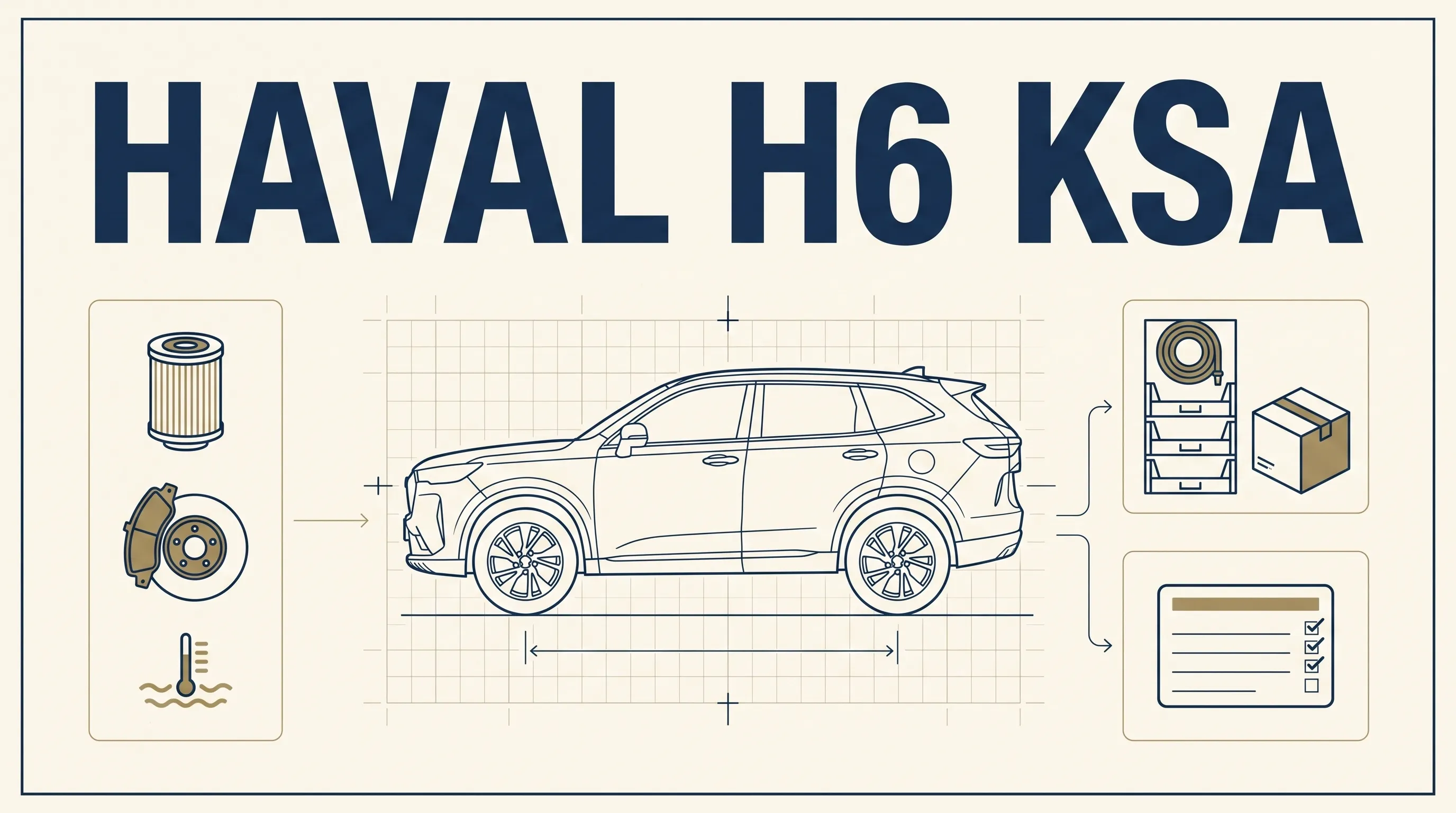
Answer Card
Buyer Decision Summary
- Problem
- Model-only sourcing can still create wrong-part, wrong-year, or wrong-version risk.
- Best control
- Build a first basket around repeat service parts, then release visual or version-risk parts only with photo proof.
- Best buyer fit
- GCC / Middle East workshops and parts shops
- Brace support
- Jordan checks OE / VIN / old-part photos, confirms stock or source options, and routes mixed-order quotes to WhatsApp.
- Next step
- Send OE / VIN / photo on WhatsApp
Quick takeaway
- Keep confirmed service filters, small service consumables, and repeated brake-pad references closest to the Saudi workshop shelf.
- Treat brake discs, suspension links, hoses, caps, and selected cooling service lines as feeder stock until repeat demand is proven.
- Keep bumpers, grilles, lamps, mirror assemblies, painted trim, radiators, condensers, fan assemblies, cameras, radar covers, and ADAS-linked brackets on VIN-verified order.
- Separate current Saudi All New Haval H6 from older H6, H6 GT, H6 HEV, and parallel-import units before releasing any fitment-sensitive part.
- Riyadh, Jeddah, Dammam, and Khobar buyers can lean harder on feeder stock; smaller-city workshops need slightly deeper coverage for proven filters and pads.
Definition: A VIN-verified order is a Haval H6 part released only after the workshop confirms VIN, build date, Saudi LHD/GCC-spec status, trim, powertrain, wheel or brake package, side, photos, and sensor or connector content where relevant.
Benchmark note: Unless otherwise stated, the opening-depth and local-versus-feeder guidance in this article is based on recent Brace order handling for Gulf LHD Chinese-brand SUV workshop and distributor inquiries from April to early May 2026. It is a practical working benchmark, not a universal market average.
Why does Haval H6 deserve a controlled Saudi parts program?
Haval H6 is a strong Saudi parts topic because it has visible official-market support, clear workshop demand logic, and enough variant complexity to justify a controlled stocking guide. The official Saudi page lists Active and Premium trims, VAT-included prices of SAR 89,900 and SAR 98,900, and public warranty signals, so the model is concrete enough for a sourcing guide. Haval Saudi Arabia
That does not mean Saudi workshops should build a full H6 shelf immediately. The H6 name covers current Saudi-market units, older H6 generations, H6 GT, H6 HEV, and parallel imports. Those vehicles can share buyer language while carrying different front-end, lighting, cooling, trim, and connector details.
For a parts counter, the useful question is not "is Haval H6 popular enough?" The better question is "which H6 parts can be released without a variant surprise?" Service and brake anchors can turn quickly. Lamps, bumpers, grilles, fan assemblies, condensers, mirrors, and ADAS-linked parts can create expensive wrong releases.
Which Haval H6 parts belong in first local stock?
First local stock should be compact, repeatable, and low-variant. Saudi workshops should start with parts that support routine service jobs and do not depend heavily on trim, side, lamp type, bumper opening, or camera/radar content.
A sensible first-stock list includes:
- Oil filters for the confirmed Saudi H6 application
- Engine air filters and cabin filters on the same verified release path
- Drain washers and small routine service consumables
- Front or rear brake pad sets after the exact reference repeats on matching vehicles
- Wiper lines after attachment type and lengths are confirmed
- Small clips or fasteners only when the same part repeats across verified jobs
Opening depth should stay conservative. For a small Saudi independent, 1-2 units per proven service or brake SKU is a cleaner starting point than a broad shelf across every H6 category. If a line turns and the fitment file stays clean, deepen it later.
The counterpoint matters: being too cautious can also cost good work. If the same filter or brake-pad reference repeats across verified Saudi H6 jobs, leaving every item job-based slows the workshop without reducing meaningful fitment risk.
What should stay feeder stock or VIN-verified order only?
Feeder stock should cover slower mechanical repeats, while VIN-verified order should control bulky, fragile, option-sensitive, or sensor-linked Haval H6 parts. The model is real enough to support a parts program, but not simple enough for blind body and electronics stock.
| Stock tier | Part groups | Opening depth guide | Release rule | Why it belongs there |
|---|---|---|---|---|
| Local stock | Oil filters, air filters, cabin filters, drain washers, proven brake pad sets | 1-2 units per proven SKU | Add after verified repeat jobs | Fastest turn and lowest variant risk |
| Feeder stock | Proven disc pairs, stabilizer links, selected control-arm or bushing items, hoses, caps, thermostat-related lines | 0-1 unit per proven variant | VIN, build date, trim, wheel or brake package required | Demand may repeat, but wrong-variant risk still matters |
| VIN-verified order only | Headlamps, tail lamps, bumpers, grilles, mirrors, painted trims, undertrays, radiators, condensers, fan assemblies, cameras, sensors, radar covers | Job-based only | VIN plus photos, side, connector count, lamp type, bumper opening, and underbody spec | Highest dead-stock, damage, and return risk |
Saudi heat makes cooling parts important, but heat does not make every cooling assembly shelf-safe. Hoses, caps, and smaller repeat cooling service lines may earn feeder coverage. Radiators, condensers, and fan assemblies should stay VIN-verified until repeated matching jobs prove the application.
The same logic applies to collision parts. A bumper or headlamp request proves urgency, not repeatability. One wrong lamp connector, radar opening, grille texture, or bracket position can turn a high-value item into a return dispute.
How should Saudi buyers separate current H6 from H6 GT, H6 HEV, and older H6?
Saudi buyers should separate H6 variants before price discussion, because the model name is too broad for release control. The official Saudi All New Haval H6 page lists a 2.0 L turbo FWD vehicle with 9DCT, while H6 GT, H6 HEV, older H6 generations, and parallel-import units need separate confirmation. Haval Saudi Arabia
The minimum verification file should include:
- VIN
- Build date
- Saudi-delivered or parallel-import status
- LHD and GCC-spec confirmation
- Current H6, H6 GT, H6 HEV, or older-generation separation
- Active or Premium trim where known
- Wheel size or brake package when relevant
- Side from driver seating position
- Damaged-area photos
- Old-part label photos
- Connector count and plug shape
- Camera, radar, parking sensor, and lamp type
- Bumper openings, grille texture, bracket position, and underbody shape
This file is not paperwork for its own sake. It decides whether the buyer can release a service part, route a feeder item, or keep a body, lamp, cooling-module, or ADAS-linked part on job-based order.
What does a low-risk Saudi Haval H6 pilot basket look like?
A low-risk pilot basket should test real H6 demand without forcing the workshop to carry slow, fragile, or option-sensitive stock. The basket should be narrow enough to review after the first replenishment cycle and flexible enough to drop lines that do not repeat.
A workable pilot basket starts with:
- Oil filters
- Air filters
- Cabin filters
- Drain washers and small service consumables
- Proven front brake pads
- Proven rear brake pads
- Wiper lines after attachment confirmation
- Selected small clips or fasteners after repeat demand
The pilot basket should not include:
- Bumper covers
- Grilles
- Full headlamp or tail-lamp assemblies
- Mirror assemblies before side and connector confirmation
- Radiators, condensers, or fan assemblies before repeat matching jobs
- Cameras, radar covers, parking sensors, or ADAS-linked brackets
- Painted trim
- Undertrays or bulky plastic protection panels with unclear bracket shape
Riyadh, Jeddah, Dammam, and Khobar workshops can usually rely more on feeder stock because replenishment lanes are easier to manage. Smaller-city workshops may need slightly deeper local coverage for proven filters and pads because a missed repeat service line can cost more time.
Where does the logic fail, and what should buyers ask suppliers?
The logic fails when a supplier treats all H6 labels as interchangeable, pushes body and lamp stock before demand repeats, or refuses to separate Saudi LHD/GCC-spec vehicles from parallel imports. In those cases, local inventory looks impressive but does not protect the workshop from wrong-release cost.
Before committing shelf space, ask suppliers these questions:
- Will you release Haval H6 parts by VIN and build date, not by model name alone?
- How do you separate current Saudi All New Haval H6, older H6, H6 GT, and H6 HEV?
- How do you separate Saudi LHD/GCC-spec vehicles from parallel-import units?
- What photos do you require for lamps, bumpers, grilles, mirrors, cooling modules, and undertrays?
- Can slower H6 items stay in feeder stock instead of my local shelf?
- How are headlamps, bumpers, grilles, condensers, radiators, and undertrays packed before dispatch?
- What happens if the workshop supplied incomplete vehicle data and the part was mis-released?
Brace Auto Parts is one example of a supplier workflow built around mixed-brand Chinese SUV sourcing, flexible order handling, and photo verification before shipment. That does not remove the buyer's responsibility to confirm VIN, old-part proof, trim details, and sensor or connector content before releasing Haval H6 parts.
Operational verdict
Saudi Haval H6 stocking should start narrow and stay evidence-led. Keep confirmed service filters, small consumables, and repeated brake references local; use feeder stock for slower mechanical repeats; and keep collision, lighting, cooling-module, trim, and sensor-linked parts on VIN-verified order. This gives Saudi workshops practical H6 coverage without turning variant-sensitive parts into avoidable returns.
FAQ
Should Saudi workshops stock Haval H6 parts now?
Yes, but only as a controlled first line. Start with verified service filters, small consumables, and repeated brake references before widening into slower mechanical or body-related categories.
Which Haval H6 parts are safest for first local stock?
Oil filters, air filters, cabin filters, drain washers, and proven brake pads are the safest starting point. They turn through routine work and carry less trim, side, or connector risk.
Why should Haval H6 lamps and bumpers stay on VIN-verified order?
Lamps and bumpers can change by trim, connector, side, sensor opening, radar content, bracket, and grille detail. They are also bulky or fragile, so one wrong release costs more than a wrong filter.
Are cooling parts safe to keep locally in Saudi heat?
Cooling demand matters in Saudi Arabia, but radiators, condensers, and fan assemblies should not be treated as blind shelf stock for a newer or mixed-variant H6 line. Start with repeat service cooling items, then move proven assemblies into feeder stock.
How should buyers separate H6, H6 GT, H6 HEV, and older H6 parts?
Use VIN, build date, powertrain, trim, Saudi-market status, photos, and old-part labels. The H6 name alone is not enough for body, lamp, cooling, mirror, or sensor-linked releases.
What data should a workshop send before ordering Haval H6 collision parts?
Send VIN, build date, Saudi or parallel-import status, trim, side, damaged-area photos, old-part label photos, connector count, sensor positions, bumper openings, and bracket details.
When should a Saudi workshop expand the Haval H6 basket?
Expand after the same part repeats on verified matching vehicles and the fitment file stays clean. If a line does not repeat, keep it feeder or job-based instead of forcing it onto the shelf.
Public references
Buyer Downloads
Use This Guide In A Real RFQ
RFQ Template
Copy This RFQ Format
Brand / model:
Year:
OE number:
VIN:
Old part photo:
Quantity:
Destination:
Need photo confirmation before shipment? Yes / No