Answer Card
Buyer Decision Summary
- Problem
- Model-only sourcing can still create wrong-part, wrong-year, or wrong-version risk.
- Best control
- Build a first basket around repeat service parts, then release visual or version-risk parts only with photo proof.
- Best buyer fit
- GCC / Middle East parts shops and distributors
- Brace support
- Jordan checks OE / VIN / old-part photos, confirms stock or source options, and routes mixed-order quotes to WhatsApp.
- Next step
- Send OE / VIN / photo on WhatsApp
Quick takeaway
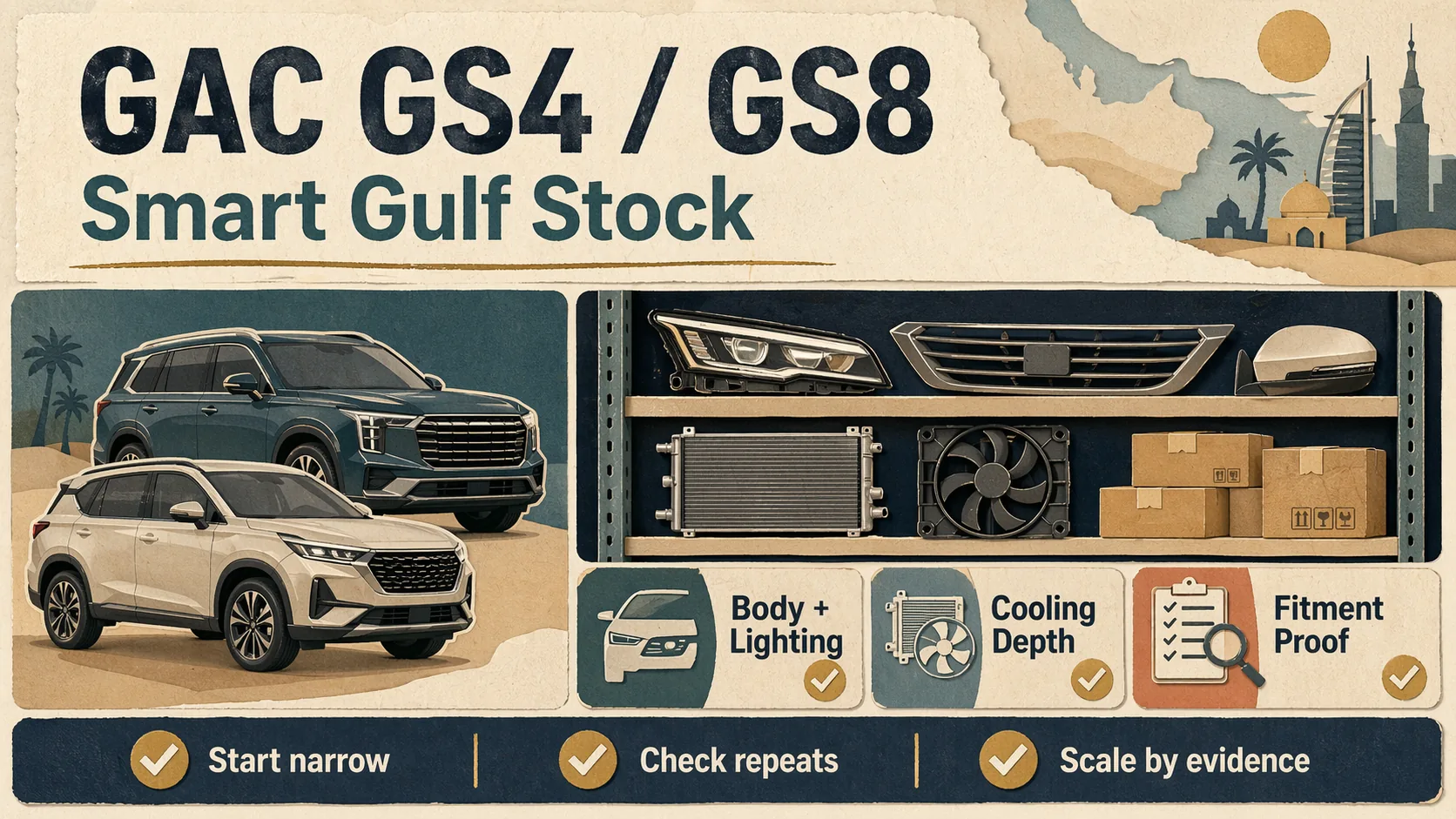
Build coverage in layers, not in one complete-looking basket. Keep compact repeat lines close, release visual-risk items with photo confirmation, and delay bulky panel stocking until demand repeats.
Benchmark note: Basket ranges in this article come from Brace Auto Parts export planning records (2024-2026). They are practical references, not market averages.
What does thin aftermarket depth mean in this context?
It means vehicles are on the road, but parts-channel consistency is still developing. You may see real workshop demand before supplier-side fitment routines, stock depth, and proof discipline become stable.
Why should GS4 and GS8 be managed separately?
They create different risk profiles. GS4 is usually easier to build around repeat service and cooling demand; GS8 tends to increase carton volume, trim sensitivity, and bulky-panel exposure.
Which layers should be controlled first?
| Layer | Parts focus | Stock stance | Why it matters |
|---|---|---|---|
| Service | Filters, pads, wear items | Small local depth | Supports repeat bay flow |
| Cooling | Radiator, condenser, fan, hose | Add after repeat signals | Gulf heat punishes weak coverage |
| Front repair | Lamps, grille, supports, brackets | Selective feeder depth | Reduces cycle-time stalls |
| Large panels | Hood, doors, bumper skins | Job-based first | High space and handling risk |
How should the first 90-day test be run?
- Split GS4 and GS8 demand tracking from day one.
- Confirm GCC/LHD fitment details for visual and mirror/lamp lines.
- Build a compact service/cooling base first.
- Add front-end lines only where repair patterns repeat.
- Keep bulky panels job-based until at least two similar jobs recur.
- Reassess movement and claims data before adding depth.
What should a supplier prove before you scale?
A reliable supplier should show clear ready-stock vs sourcing separation, photo-backed release on visual-risk lines, and practical guidance on which bulky lines should stay job-based.
What should buyers measure in the first 30 days?
| Metric | Healthy pilot signal | Warning trigger |
|---|---|---|
| Model split discipline | GS4/GS8 tracked separately | One merged basket without risk split |
| Proof quality | Photo confirmation on risky lines | Generic images only |
| Stock transparency | Ready vs sourcing clearly labeled | "Everything available" replies |
| Claims ownership | First response within 48h | No clear path after 72h |
| Shelf movement | Repeat lines identified by week 4 | No visibility on line turnover |
Common questions
Should GS4 and GS8 share one stocking list?
They can share suppliers, but stock logic should remain separate.
Which lines are safest for early stock?
Compact service items, selected cooling lines, and proven front-end repeat lines.
Should GS8 body panels be stocked early?
Usually no; keep them job-based until repeat demand is clear.
What proof matters most before release?
VIN/variant checks, side confirmation, connector photos, and pre-pack images.
How many lines should be in phase one?
A compact base (roughly 8-12) is usually enough to test movement quality.
Operational verdict
GS4 and GS8 can be strong Gulf lines when treated as a controlled replenishment program. Keep phase-one baskets compact, separate model risk, and expand only from repeat evidence.
Public references
Buyer Downloads
Use This Guide In A Real RFQ
RFQ Template
Copy This RFQ Format
Brand / model:
Year:
OE number:
VIN:
Old part photo:
Quantity:
Destination:
Need photo confirmation before shipment? Yes / No