Answer Card
Buyer Decision Summary
- Problem
- Model-only sourcing can still create wrong-part, wrong-year, or wrong-version risk.
- Best control
- Build a first basket around repeat service parts, then release visual or version-risk parts only with photo proof.
- Best buyer fit
- GCC / Middle East workshops and parts shops
- Brace support
- Jordan checks OE / VIN / old-part photos, confirms stock or source options, and routes mixed-order quotes to WhatsApp.
- Next step
- Send OE / VIN / photo on WhatsApp
Quick takeaway
- UAE workshops should treat Jetour T2 as a controlled first-stock line, not a broad shelf program, because early service demand does not mean the independent aftermarket has stable coverage across every variant
- The safest local stock is the repeat service-and-brake core: filters, routine service consumables, and only the brake references that have already repeated on the same verified vehicle configuration
- Bulky, fragile, or option-sensitive parts such as lamps, bumpers, mirrors, cooling modules, trims, and sensor-linked components should stay on verified order because one wrong release can create dead stock, carton damage, or return disputes
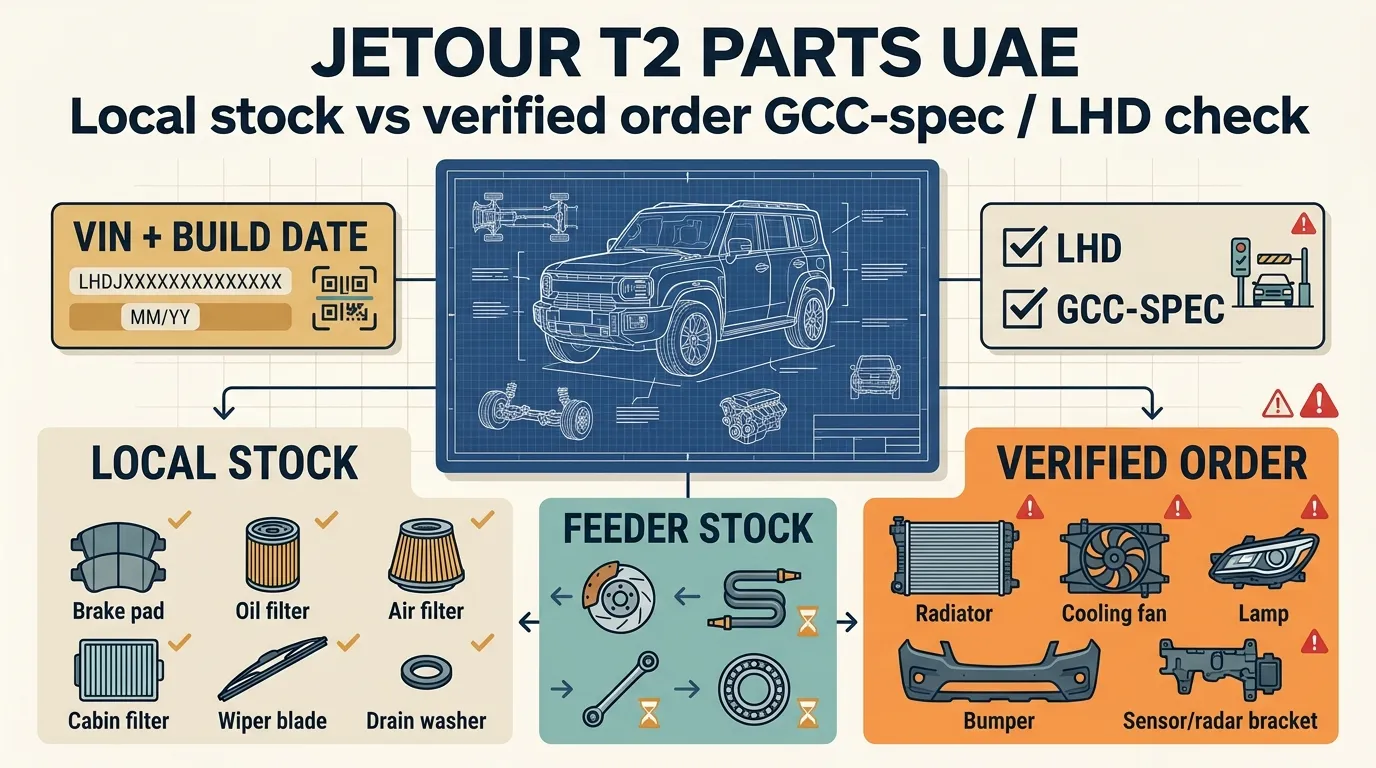
- A three-tier approach works best: local shelf for fast movers, feeder stock for slower mechanical repeats, and job-based ordering for collision, lighting, cooling, and trim items
- Buyers should not release Jetour T2 parts by model name alone; they should confirm VIN, build date, LHD and GCC-spec status, trim and wheel package, and any camera, radar, lamp, or underbody differences before supply
Definition: In this guide, a verified order is a part released only after the workshop confirms VIN, build date, LHD and GCC-spec status, trim or ADAS content, and any side, lamp, wheel, or underbody differences that affect fitment.
Benchmark note: The opening depths, pilot-basket ranges, and review intervals in this guide are based on recent Brace order handling for Gulf LHD Chinese-brand SUV workshop and distributor inquiries during April-May 2026. They are practical working benchmarks, not a universal market average.
Why is Jetour T2 a difficult stock line in the UAE right now?
Jetour T2 is difficult because it is new enough in the UAE that service demand can appear before independent parts coverage becomes deep. Jetour UAE presents the current T2 in this market as a 2.0T model with 390 Nm of torque, a 7-speed DCT, 4,785 mm length, and a 2,800 mm wheelbase, but that still does not make it a one-code buy. Jetour UAE
The same official page lists a 10-year / 1 million km warranty and a 3-year or 30,000 km service package. Those ownership signals may keep T2 vehicles in structured service longer, but they do not remove the independent buyer's fitment risk once a workshop starts sourcing service, brake, cooling, or collision parts outside the dealer lane. Jetour UAE
The problem is not the basic powertrain headline. The problem is release control. On a newer SUV, trim level, lamp type, bumper openings, parking sensor count, camera or radar content, wheel package, and underbody protection can all change what actually fits.
That matters more in the UAE than in a single-brand market. Most independent workshops in Dubai and Sharjah are mixed-brand businesses. Their shelf space already carries high-turn Japanese, Korean, and Chinese service stock, so every slow-moving T2 carton competes with faster lines.
Heat also sharpens the buying risk. Cooling parts, seals, trims, and electronics live in harsher conditions, and buyers do not want the wrong radiator, fan assembly, or lamp unit sitting in a hot warehouse because it was released by model name alone.
GCC-spec versus parallel-import risk adds another layer. Even when the vehicle badge says T2, buyers still need to separate UAE-market vehicles from other-market arrivals and confirm LHD details before accepting fitment claims.
Which Jetour T2 parts should a workshop stock locally first?
A workshop should stock only the narrowest repeatable Jetour T2 line first: service consumables and brake references that have already repeated on the same verified vehicle pattern. That gives useful repair speed without turning a new-model line into dead stock.
For most small UAE independents, the first local stock should look like this:
- Oil filters for the confirmed UAE-market application
- Engine air filters and cabin filters for the same verified release path
- Routine service consumables such as drain plug washers and similar low-risk service items
- Front or rear brake pad sets only after that exact reference has repeated on matching vehicles
- Brake disc pairs only after the same wheel and brake package has shown repeat demand
- Wiper blades or refills only after attachment type and lengths are confirmed across more than one car
This is a practical service-and-brake anchor, not a full catalog. It keeps first-visit maintenance work moving while avoiding the most expensive release mistakes.
Workshops should resist the urge to stock visually obvious parts just because they feel urgent. Headlamps, bumper grilles, fog surrounds, mirror units, side trims, radar covers, and undertrays create more fitment risk than service filters, and they take more space to store safely.
The same caution applies to cooling assemblies. UAE heat makes cooling performance important, but that does not automatically make radiators, condensers, or fan modules safe local shelf stock for a newer model. Until repeated matching jobs prove the application, cooling assemblies are better handled through feeder stock or verified order.
What should stay in local stock, feeder stock, and verified order only?
Most Jetour T2 buyers need a three-tier plan, not a yes-or-no plan. Local stock should cover quick service work, feeder stock should support slower mechanical repeats, and verified order should absorb the high-variation body, lamp, cooling, and sensor-linked items.
| Stock tier | Part groups | Opening depth guide | Release rule | Why it belongs there |
|---|---|---|---|---|
| Local stock | Oil filters, air filters, cabin filters, drain washers, proven front or rear pad sets | 1-2 units per SKU | Add only after 2 matching jobs | Fastest turn and lowest variant risk |
| Feeder stock | Proven disc pairs, selected hub or bearing items, repeat hoses or thermostat items after demand is proven | 0-1 unit per proven variant | VIN, build date, and wheel or brake package required | Demand may repeat, but wrong-variant risk still matters |
| Verified order only | Headlamps, tail lamps, bumpers, grilles, mirrors, trims, undertrays, radiators, condensers, fan assemblies, cameras, sensors, radar covers | Job-based only | VIN plus photos, side, sensor count, lamp type, bumper opening, and underbody spec | Highest dead-stock, damage, and return risk |
Feeder stock is the middle ground many workshops miss. It means the part exists in a trusted upstream location, ready for controlled release, without consuming your own shelf space. That works well for slower T2 mechanical demand that is real but not daily.
This tier matters because T2 demand will not look the same across all shops. A Dubai workshop doing repeat service on the same few customer vehicles may justify feeder access to discs or selected chassis items. A smaller regional workshop may never see enough repetition to hold anything beyond filters and pads.
Carton logic also supports the three-tier model. Bumpers, lamp units, and undertrays are awkward, easy to damage, and poor users of shelf space. Even when they are available quickly, they are better held upstream and released job by job.
How should buyers verify fitment before placing any T2 order?
Buyers should put every Jetour T2 order through a strict release process, because one wrong lamp, grille, or cooling module can wipe out the margin from several routine services. The model should not be released by name alone.
A workable control sequence is:
- Capture the vehicle identity first. Get VIN, registration details, and build date before discussing part numbers.
- Confirm market and steering layout. Separate GCC-spec UAE vehicles from parallel imports and confirm LHD status.
- Classify the job type. Service, brake, cooling, front collision, rear collision, and suspension jobs each need different checks.
- Check the release-control variables. Confirm trim, wheel package, lamp type, parking sensor count, camera or radar presence, bumper openings, and underbody protection.
- Collect photos for visual items. For lamps, mirrors, grilles, trims, undertrays, and bumper-related parts, clear vehicle photos reduce avoidable mis-release.
- Ask the supplier what the release is based on. A reliable release should reference VIN, build data, or matched visual controls, not just a generic T2 listing.
Even with the narrow public powertrain scope shown on the official Jetour UAE T2 model page, fitment control still matters because service parts and collision parts do not carry the same release risk.
The riskiest orders are the ones that combine visual similarity with hidden variation. A bumper may look correct until parking sensor count, camera position, lower opening shape, or radar cover detail proves otherwise. A lamp may look right until connector or hidden specification differences appear. Those are verified-order items for a reason.
What does a low-risk first pilot basket look like for a UAE workshop?
A low-risk first Jetour T2 buy should be small, repeat-driven, and biased toward service and brakes. Based on recent Brace order handling, a practical pilot basket is about 12-18 SKUs, with 1-2 units per SKU, reviewed after 30-45 days or 8-10 matching jobs.
A sensible pilot basket can include:
- Oil filters
- Engine air filters
- Cabin filters
- Low-cost service consumables tied to routine maintenance
- One proven front pad reference
- One proven rear pad reference
- One proven disc pair only if the same wheel and brake package has repeated
- Wiper sets only after repeat confirmation of size and attachment
What should stay out of the pilot basket is just as important:
- Headlamp and tail lamp units
- Bumper covers, bumper grilles, and sensor or radar covers
- Mirror assemblies and painted or textured trims
- Radiators, condensers, and fan assemblies unless your own demand pattern proves them
- Undertrays, protector plates, and lower body plastics
This is where many first-time buyers overreach. They see one collision repair and start building a body stock line. That is the wrong lesson. Collision demand proves urgency, not repeatability.
A counterpoint is worth stating. If your workshop already has recurring T2 traffic on the same configuration, or if you support a fleet or enthusiast customer base with matching builds, you may justify a wider brake and chassis basket sooner. The key is repeated matching jobs, not optimism.
Where does this logic fail, and what should you ask any supplier?
This logic fails when your actual job flow is more concentrated than the average mixed-brand workshop, or when your supplier cannot control release quality. In both cases, the answer is not blind stocking. It is sharper pattern recognition and sharper supplier screening.
The first failure case is repeated identical demand. If the same T2 trim, wheel package, and service pattern keeps returning, you can widen the line beyond filters and pad sets. That might include disc pairs or selected mechanical items, but only after the repetition is real.
The second failure case is poor supplier discipline. A supplier that cannot separate GCC-spec from parallel-import vehicles, or cannot explain why a lamp, grille, or cooling part fits, turns every order into a return risk.
Before you commit shelf space, ask any supplier these questions:
- Will you release Jetour T2 parts by VIN and build date, not by model name alone?
- How do you separate GCC-spec UAE vehicles from parallel-import units?
- What details do you require for lamps, bumpers, mirrors, grilles, and sensor-linked parts?
- Can you confirm wheel package, brake size, and visual option differences before release?
- Can slower T2 items stay in feeder stock instead of my local shelf?
- How are bulky cartons such as bumpers, lamps, and undertrays packed and checked before dispatch?
- What happens if the workshop supplied incomplete vehicle data and the part was mis-released?
If a supplier answers those questions clearly, the workshop can run a narrow T2 line with less cash risk. If the answers are vague, keep the line even narrower.
Operational verdict
Jetour T2 in the UAE should be treated as a narrow local-stock line, not a broad shelf program. Keep service consumables and proven brake references close, use feeder stock for slower mechanical repeats, and put body, lighting, cooling, trim, and sensor-linked items on verified order. On a newer 2.0T, 7-speed DCT SUV, release accuracy matters more than shelf depth.
FAQ
Should UAE workshops stock Jetour T2 parts now?
Yes, but only as a narrow first line. Start with repeatable service consumables and proven brake references, then widen only after your own job history shows consistent matching demand.
Which Jetour T2 parts are safer for local stock?
Filters, low-cost routine service consumables, and brake pads that have already repeated on the same verified vehicle pattern are the safest opening stock. They carry lower fitment and storage risk than body or lighting items.
Why should body parts stay on verified order?
Body parts carry the highest variation and damage risk. Side, lamp type, parking sensors, bumper openings, camera or radar content, and trim details can all change fitment, and bulky cartons are expensive to store badly.
Should brake discs be stocked locally from day one?
Not by default. Hold discs locally only after the same wheel and brake package has repeated enough to justify shelf space; otherwise, keep them in feeder stock or on controlled order.
How do GCC-spec and parallel-import vehicles change Jetour T2 buying risk?
They increase the chance of wrong fitment if buyers release by model name alone. Workshops should confirm market origin, LHD status, and vehicle details before ordering anything beyond low-risk service items.
What information should a buyer send before ordering T2 collision parts?
Send VIN, build date, LHD and market status, photos of the damaged area, side identification, lamp details, parking sensor count, and any camera or radar content. That is the minimum data needed to reduce mis-release.
When is it reasonable to widen the pilot basket?
Widen it when the same verified T2 configuration repeats in your own workshop. Repetition across 8-10 matching jobs is a more useful signal than one urgent repair.
Public references
Buyer Downloads
Use This Guide In A Real RFQ
RFQ Template
Copy This RFQ Format
Brand / model:
Year:
OE number:
VIN:
Old part photo:
Quantity:
Destination:
Need photo confirmation before shipment? Yes / No