Answer Card
Buyer Decision Summary
- Problem
- Model-only sourcing can still create wrong-part, wrong-year, or wrong-version risk.
- Best control
- Confirm OE number, VIN, build year, side, connector, and old-part photos before quote.
- Best buyer fit
- Global export buyers workshops and parts shops
- Brace support
- Jordan checks OE / VIN / old-part photos, confirms stock or source options, and routes mixed-order quotes to WhatsApp.
- Next step
- Send OE / VIN / photo on WhatsApp
Quick takeaway
Treat CKD/CBU fitment as a process-control issue, not a catalog issue. If your supplier can confirm variant details before pricing, separate high-risk lines, and provide usable pre-pack proof, you can expand with less risk.
Benchmark note: Workflow ranges in this article are based on Brace Auto Parts sourcing/order-handling records (2024-2026), mainly from Gulf and export workshop scenarios. They are decision references, not universal market rules.
What do CKD and CBU mean for practical parts matching?
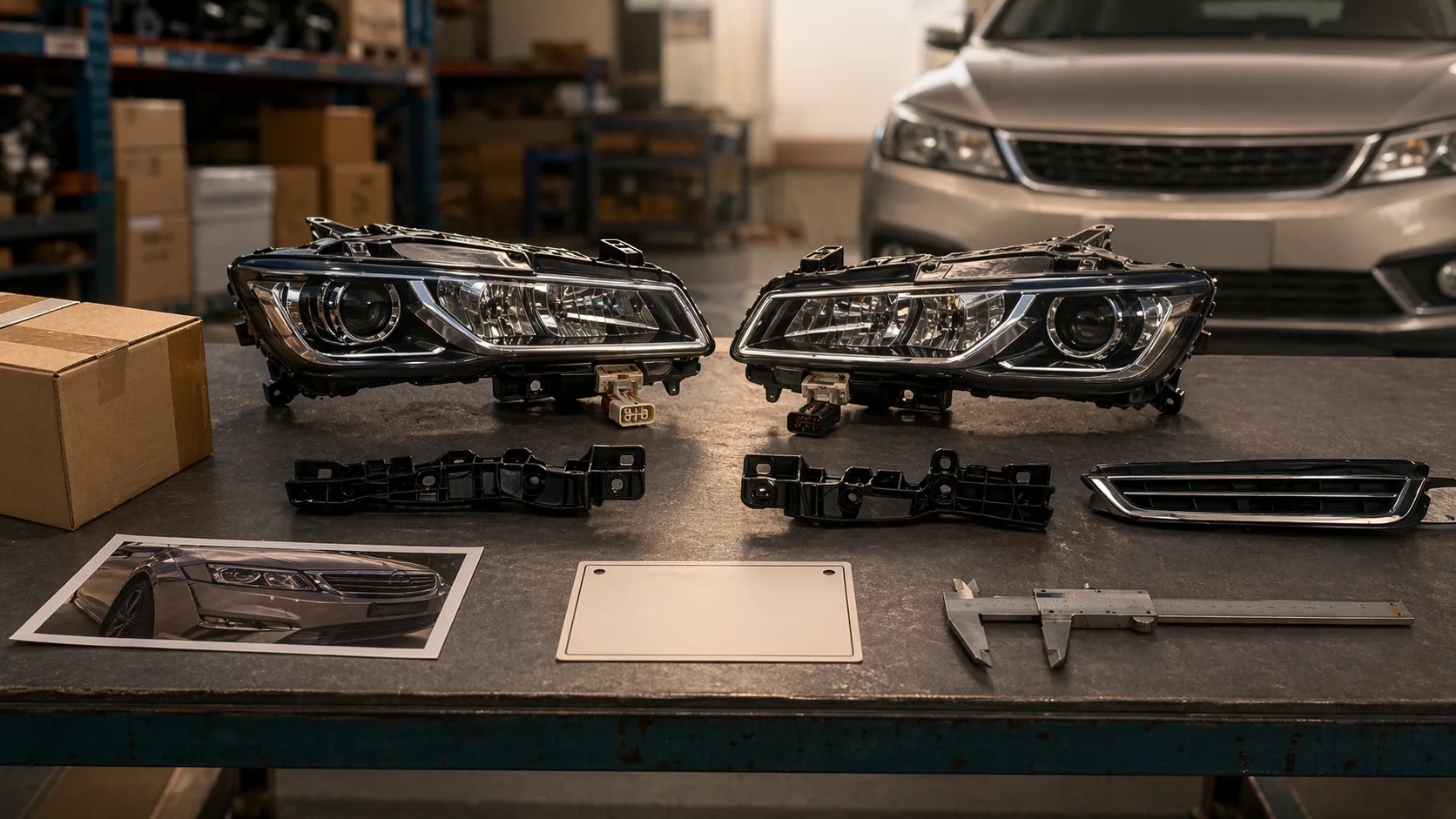
CKD vehicles are assembled locally from imported kits; CBU vehicles arrive as fully built units. For buyers, that difference can affect lamps, fascia trim, connector types, mounting points, and minor body details.
Why is CKD/CBU mixing a real workshop risk?
Most failures happen on visual or connector-sensitive lines, not on easy service items. Once paint time and bay scheduling are committed, even small variant errors become expensive.
Which parts should be controlled first?
| Control layer | Parts focus | Release checkpoint | Why it matters |
|---|---|---|---|
| Body front | Bumper skin, grille, fog trim | Fascia version + sensor-hole check | High visual dispute risk |
| Lighting | Headlamp, tail lamp | Connector + side confirmation | Wrong connector blocks installation |
| Cooling | Radiator, condenser, fan | Mount + engine-variant check | Heat-related failures escalate quickly |
| Interior trim | Switches, garnish, handles | Finish + batch confirmation | Slower turnover, higher complaint rate |
How should workshops run a 90-day Emgrand fitment test?
- Confirm CKD or CBU source before accepting model-name matching.
- Collect VIN, build month, and old-part/damage photos.
- Split high-risk visual lines from routine service lines in the quote.
- Mark uncertain lines as confirm-before-release.
- Start with compact repeat lines before stocking bulky panels.
- Recheck the same logic on a second order before expanding.
What does a low-risk first order look like?
A safer first basket is compact and mixed: service/cooling first, selective front-end repair second, bulky cosmetics job-based. Use a 12-point gate: VIN, build month, market source, LHD/RHD, engine, transmission, fascia version, lamp connector, sensor holes, radiator mount, trim finish, old-part photos.
What should buyers measure in the first 30 days?
| Metric | Healthy pilot signal | Escalation trigger |
|---|---|---|
| VIN/build confirmation | Provided before quote on risky lines | Quote from model name alone |
| Photo-proof behavior | Photos requested/sent on visual-risk lines | No photo path on risky lines |
| Connector accuracy | Lamp connector checked pre-release | Connector guessed from catalog image |
| Variant clarity | CKD-sensitive vs universal lines separated | All lines treated as one group |
| Claims first response | Reply within 48h | No ownership path after 72h |
What should buyers ask before release?
- Which Emgrand lines are CKD/CBU-sensitive in this order?
- Which parts require old-part photos before dispatch?
- Which lines are universal service items versus visual-risk items?
- What proof can be provided before packing for risky lines?
Common questions
Can Emgrand parts be matched by model name alone?
Not safely in mixed CKD/CBU markets, especially for body, lamp, cooling, and trim lines.
Which lines usually fail first?
Front-end body parts, lamps/connectors, cooling mounts, and trim-sensitive pieces.
What is the minimum pre-release data set?
VIN, build month, market source, LHD/RHD, and old-part photos on risky lines.
Should bulky panels be stocked early?
Usually no; keep them job-based until repeat accident demand is visible.
Is one clean first order enough to scale?
No. Confirm consistency on at least one follow-up cycle.
Operational verdict
For Emgrand CKD/CBU sourcing, reliability comes from repeatable confirmation behavior, not broad catalog coverage. Scale only after the supplier demonstrates consistency across two cycles with clear proof and stable claims handling.
Public references for specification cross-checking
Buyer Downloads
Use This Guide In A Real RFQ
RFQ Template
Copy This RFQ Format
Brand / model:
Year:
OE number:
VIN:
Old part photo:
Quantity:
Destination:
Need photo confirmation before shipment? Yes / No