Answer Card
Buyer Decision Summary
- Problem
- Model-only sourcing can still create wrong-part, wrong-year, or wrong-version risk.
- Best control
- Confirm OE number, VIN, build year, side, connector, and old-part photos before quote.
- Best buyer fit
- GCC / Middle East workshops and parts shops
- Brace support
- Jordan checks OE / VIN / old-part photos, confirms stock or source options, and routes mixed-order quotes to WhatsApp.
- Next step
- Send OE / VIN / photo on WhatsApp
Quick takeaway
For fitment-sensitive CS75 lines, a 7-check gate is one of the safest ways to control first-cycle release risk. When evidence is incomplete, those lines are better kept job-based rather than pushed into early stock depth.
Benchmark note: The 7-check gate is a Brace workflow method based on Brace Auto Parts sourcing records. It is intended as a practical release discipline, not as a claim that every CS75 part differs across every market.
What does year-range release mean in workshop terms?
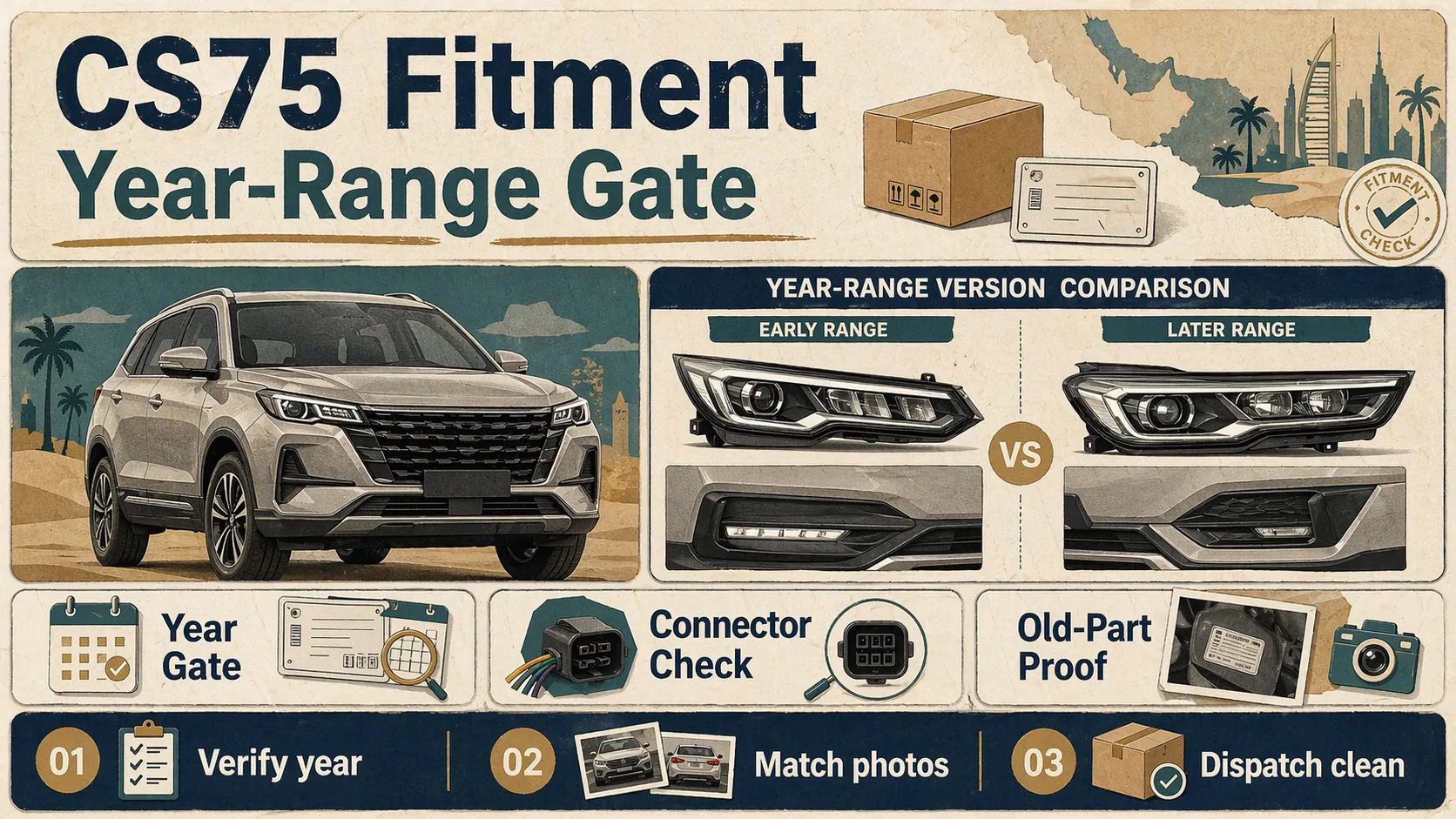
In practice, year-range release means confirming the production period and visible revision before quoting, instead of assuming that one CS75 family always equals one universal fitment line. The goal is straightforward: catch mismatch before payment and packing.
Why does the risk exist even when the vehicle looks similar?
Small revisions can still affect installation in a very real way. Lamps, bumper seams, grille geometry, mirror details, connector types, and cooling mounts may differ enough to block fitment, even when the vehicle still looks broadly similar.
Which part groups need the strongest control?
| Part group | Typical request | Required evidence | Main risk |
|---|---|---|---|
| Front body | Bumper, grille, supports | Front photo and build year | Bracket or seam mismatch |
| Lighting | Headlamp, tail lamp | Connector and side proof | Installation blocked |
| Cooling | Radiator, condenser, fan | Engine and mount detail | Heat issues or comeback risk |
| Mirrors and trim | Mirror, garnish, switches | Side and finish confirmation | Customer-facing disputes |
How should workshops run the first 90-day CS75 test?
For risky lines, do not accept release based on model name alone. Request VIN and build year before quoting visual parts. For body and lighting jobs, collect front and rear photos. On cooling and electrical lines, old-part labels are often the most useful reference. Year-sensitive lines should be separated from universal service items, and uncertain variants should stay job-based until repeat evidence appears.
How should workshops run a CS75 release gate?
- Confirm model year, market background, and trim before price comparison.
- Ask for old-part photos on lamps, bumpers, mirrors, cooling parts, and trim-sensitive lines.
- Separate ready stock from sourced stock before promising repair timing.
- Require supplier photos for the highest-risk 2-3 lines before dispatch.
- Review fitment accuracy after the first order before adding deeper local stock.
What should a supplier show directly in the quote?
A useful quote should clearly flag uncertain lines, show what evidence was used, separate ready stock from sourcing items, and indicate which parts can be matched safely by model name and which cannot.
What should buyers measure in the first 30 days?
| Metric | Sign the process is working | Sign to pause |
|---|---|---|
| Variant discipline | VIN and year proof present on risky lines | Model-name-only quote |
| Photo usage | Front/rear/side photos used in release | No visual evidence path |
| Connector control | Lamp connector checked before release | Connector guessed |
| Risk labeling | Year-sensitive lines marked in quote | All lines treated as universal |
| Claims response | First ownership taken within 48h | No ownership path by 72h |
Common questions
Can CS75 bumpers be stocked locally from day one?
Usually only after the same year range begins to repeat.
Are lamps riskier than routine service parts?
Yes. Connector, side, and version errors usually stop installation immediately.
What is the minimum useful confirmation set?
VIN, build year, front and rear photos, connector detail, old-part label, and left/right confirmation.
Should cooling lines always require old-part proof?
For uncertain variants, yes. It helps reduce mount and engine-spec errors.
Is one clean order enough to scale stock?
Usually not. Confirm consistency on at least one follow-up cycle.
Operational verdict
CS75 fitment becomes much easier to control when year range is treated as a release gate rather than something to solve after dispatch. Scale only from repeat evidence, and keep uncertain visual lines under photo-backed control until the process has proved consistent.
Public references
Buyer Downloads
Use This Guide In A Real RFQ
RFQ Template
Copy This RFQ Format
Brand / model:
Year:
OE number:
VIN:
Old part photo:
Quantity:
Destination:
Need photo confirmation before shipment? Yes / No