Answer Card
Buyer Decision Summary
- Problem
- Model-only sourcing can still create wrong-part, wrong-year, or wrong-version risk.
- Best control
- Build a first basket around repeat service parts, then release visual or version-risk parts only with photo proof.
- Best buyer fit
- GCC / Middle East workshops and parts shops
- Brace support
- Jordan checks OE / VIN / old-part photos, confirms stock or source options, and routes mixed-order quotes to WhatsApp.
- Next step
- Send OE / VIN / photo on WhatsApp
Quick takeaway
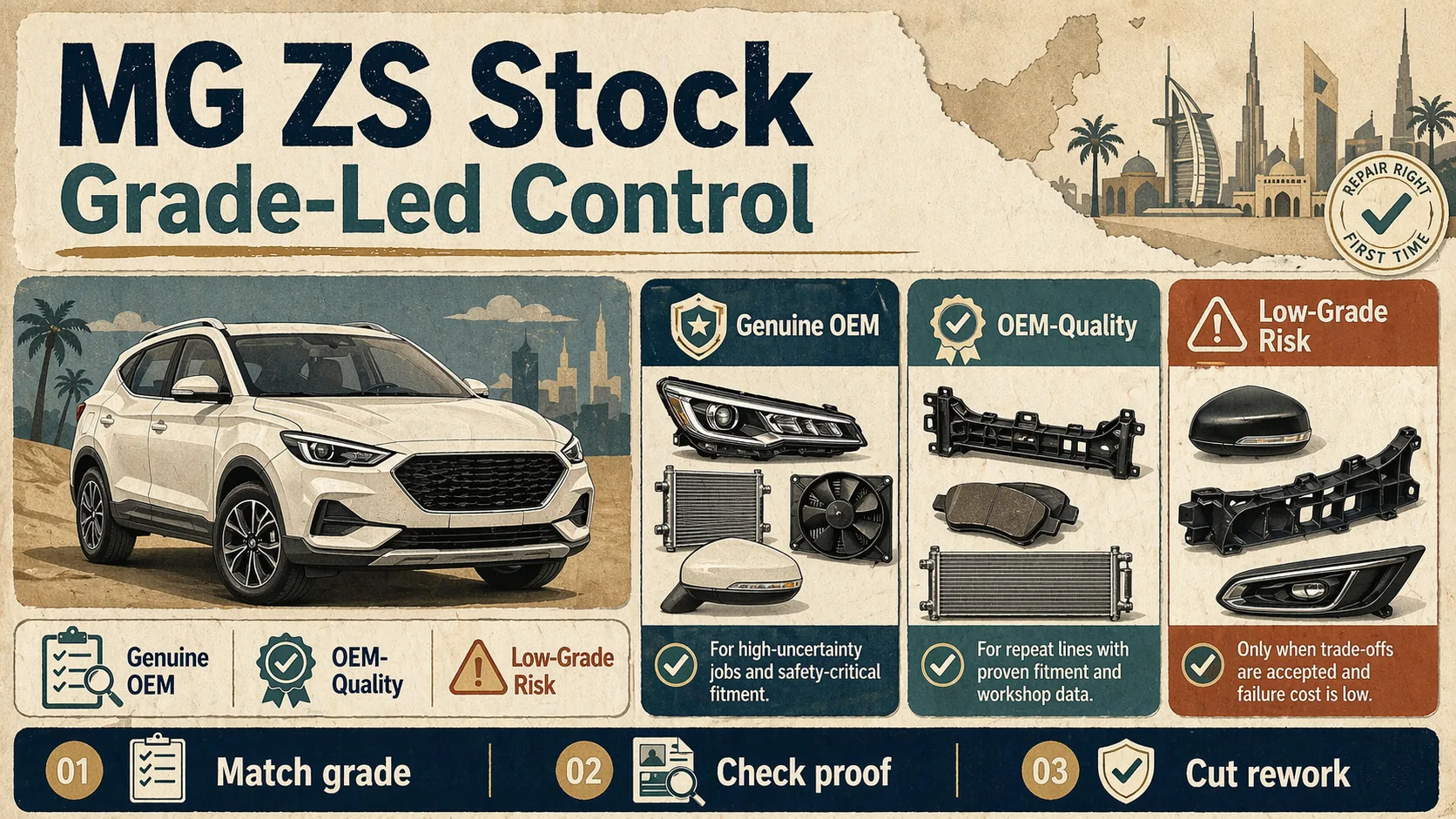
On MG ZS, grade choice should follow repair risk, not just quote ranking. Keep repeat service and cooling lines close when OEM-quality aftermarket performance is proven. For lamps, mirrors, bumper details, and sensor-sensitive parts, release should stay proof-led and grade-explicit before dispatch.
Benchmark note: The 3-grade method is based on Brace Auto Parts export handling records. It is a practical decision framework, not a universal grade rule for every order.
What does grade-led stocking mean in workshop terms?
It means deciding part grade by consequence of failure in the bay, not by headline unit price. A part can be model-correct and still be wrong for the job if finish consistency, bracket precision, or sensor compatibility is weak.
Why is price-first logic risky for MG ZS in UAE workshops?
Price-first logic often hides downstream cost: refit hours, paint delays, customer-facing disputes, and bay occupancy pressure.
Which MG ZS part groups should be prioritized first?
| Part group | Stock stance | Grade logic | Main risk |
|---|---|---|---|
| Service/wear | Local depth | Proven OEM-quality aftermarket | Daily bay continuity |
| Cooling | Local after repeat turnover | OEM-quality with mount proof | Heat/comeback risk |
| Front-end repair | Selective depth | Grade confirmed pre-release | Cycle-time pressure |
| Visual/sensor-sensitive | Confirm-before-release | Genuine or proven OEM-quality | Fit/finish/sensor mismatch |
How should the first 90-day grade test run?
- Classify each line by job consequence before comparing price.
- Use proven OEM-quality aftermarket on repeat lines with stable confirmation.
- Use Genuine OEM where safety, sensor behavior, or warranty uncertainty is high.
- Keep low-grade lines out of repeat stock unless trade-offs are documented.
- Require old-part photos on lamps, mirrors, and bumper details.
- Review returns, refit hours, and complaint patterns at day 90 before scaling.
What should buyers measure in the first 30 days?
| Metric | Sign the process is working | Sign to pause |
|---|---|---|
| Fit accuracy | Side/mount/sensor details confirmed | Generic-image release |
| Grade clarity | Grade labeled line by line | Mixed grades without explanation |
| Rework pressure | Stable fitting time on repeats | Extra trimming/refit after paint |
| Repeat movement | Service/cooling lines reorder | Visual lines stall after one job |
| Claims ownership | First response within 48h | No ownership path after 72h |
Common questions
Should workshops always choose Genuine OEM for MG ZS?
Not always. Use it where uncertainty and consequence are high.
Where do low-grade lines create the most risk?
Visible panels, lamps, mirrors, and sensor-sensitive parts.
What proof should suppliers provide before release?
Old-part photos, side confirmation, connector/mount details, sensor-hole checks, and packing photos for fragile lines.
Can genuine and OEM-quality lines appear in one quote?
Yes, if each line is clearly labeled and buyer-approved by grade.
Is one clean first order enough to scale?
Usually not. Confirm consistency on at least one follow-up cycle.
Operational verdict
MG ZS is a strong UAE workshop line when release is both grade-led and proof-led. Use grade as a risk control tool, not a pricing shortcut.
Public references
Buyer Downloads
Use This Guide In A Real RFQ
RFQ Template
Copy This RFQ Format
Brand / model:
Year:
OE number:
VIN:
Old part photo:
Quantity:
Destination:
Need photo confirmation before shipment? Yes / No