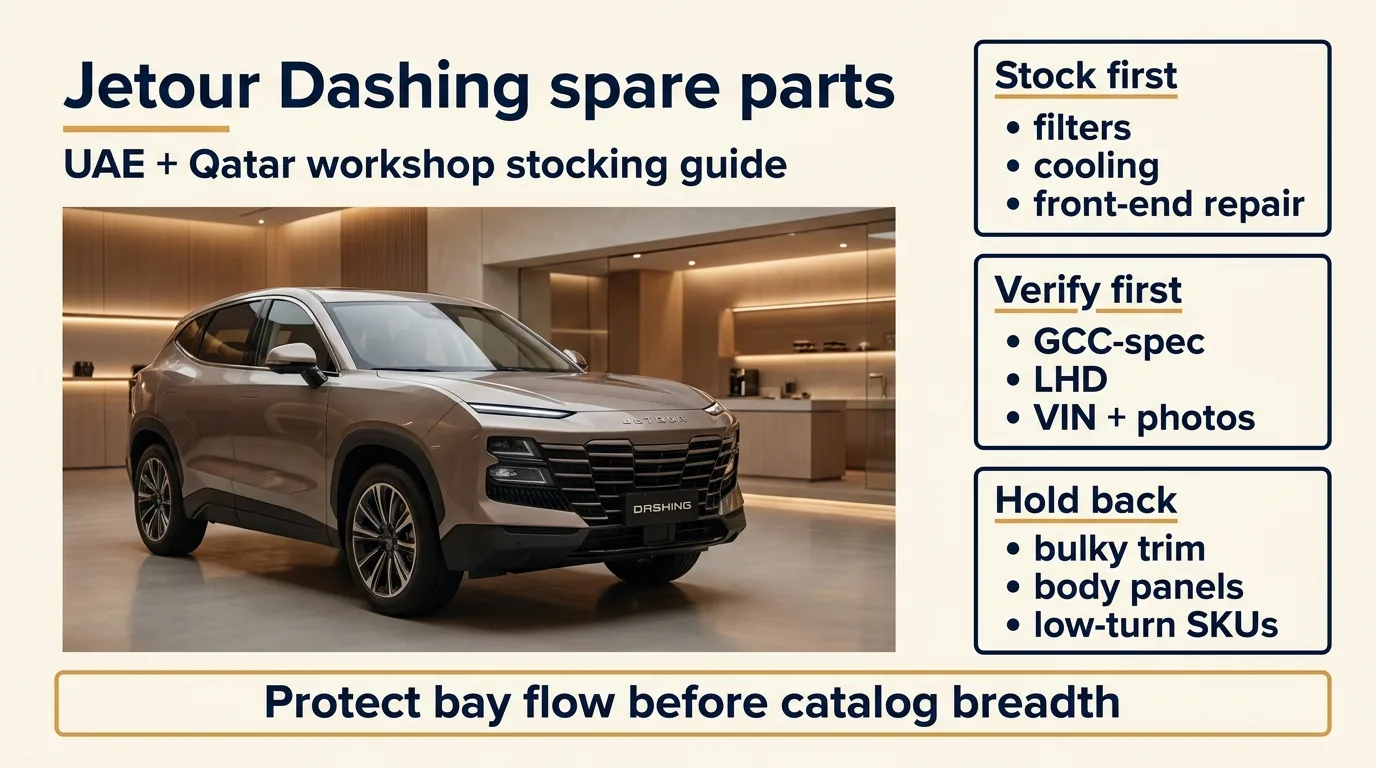
Answer Card
Buyer Decision Summary
- Problem
- Model-only sourcing can still create wrong-part, wrong-year, or wrong-version risk.
- Best control
- Build a first basket around repeat service parts, then release visual or version-risk parts only with photo proof.
- Best buyer fit
- GCC / Middle East workshops and parts shops
- Brace support
- Jordan checks OE / VIN / old-part photos, confirms stock or source options, and routes mixed-order quotes to WhatsApp.
- Next step
- Send OE / VIN / photo on WhatsApp
Quick takeaway
For UAE and Qatar workshops, Jetour Dashing spare parts are usually best handled as a controlled ramp-up rather than a broad early stocking program. Confirm GCC-spec and LHD fitment first, then keep service items, cooling parts, and a narrow set of front-end repair lines within local reach. Under the current Gulf shipping disruption, shorten the basket, tighten urgency sorting, and delay bulky trim and large body panels until routing conditions stabilize.
Benchmark note. Unless otherwise stated, pilot-order ranges and workflow observations in this article are based on Brace Auto Parts order handling and shipping records for Gulf workshop customers between 2024 and early 2026. They are practical decision support, not a universal market standard, and normal-condition lead-time assumptions do not apply during the current disruption.
Fact Gate
Time-Sensitive Logistics Claims
- Reviewed on
- 2026-05-05, using the public references listed at the end of this article.
- Next review due
- 2026-05-31, or sooner if carrier advisories change.
- Maintenance rule
- Do not reuse April 2026 routing, surcharge, booking-stop or disruption language without checking the linked carrier and market references again.
Current logistics context (as of April 2026)
Any stocking plan for UAE and Qatar today has to be read against the current Middle East shipping situation, not against pre-2026 norms.
As reviewed on 2026-05-05, treat Gulf routing as restricted and volatile, not as a normal Guangzhou-to-Sharjah sea-freight lane. AP, citing Lloyd's List Intelligence, reported that March traffic through the Strait of Hormuz fell far below the pre-war range of roughly 100 to 135 vessel passages per day. Maersk's 2026-05-04 operational update also says Strait of Hormuz transit should still be avoided under its current risk assessment.
Carrier advisories show why parts buyers should avoid hard ETA assumptions. Maersk reported booking suspensions to and from the UAE, Oman, Iraq, Kuwait, Qatar, Bahrain, and Dammam/Jubail in Saudi Arabia, while CMA CGM and Hapag-Lloyd issued their own Gulf booking-stop or disruption notices. S&P Global also reported Cape of Good Hope rerouting, war-risk surcharges, and higher disruption costs across affected trades.
For Gulf workshop buyers, this means three things in practice. Standard Guangzhou-to-Sharjah sea-freight timelines should not be treated as dependable. Bulky sea cartons are exposed to schedule slippage, rerouting, and disruption-related surcharges. Compact, high-urgency items may need air, sea-air, or staged landbridge planning until Gulf sailings stabilize.
The recommendations below are built to remain useful both during this disruption and once Gulf port services stabilize. Where a line is directly affected by current conditions, it is flagged.
How should workshops adapt the first Dashing basket during disruption?
- Move compact service, cooling, and selected front-end repair lines into the first wave.
- Hold bulky trim, bumper skins, and large panels until a live job confirms demand.
- Use air or split-mode routing for urgent, high-value compact parts where the job cannot wait.
- Confirm GCC-spec, LHD, sensor, camera, and bracket details before freight is booked.
- Review the basket once Gulf sea services and ETA reliability stabilize.
What makes Jetour Dashing parts planning difficult in the UAE and Qatar?
Jetour’s visibility across Gulf markets has grown, but aftermarket depth still varies by workshop type, repair mix, and local stocking habits. The Dashing often sits in an awkward middle stage: workshop demand is real, but parts coverage, replenishment depth, and fitment consistency are not yet equally mature across all channels.
That usually creates two operational mistakes. The first is under-stocking the service and cooling items that keep bays moving. The second is over-committing to bulky, low-frequency trim and body lines before repeat demand has been proven. The current shipping disruption sharpens both mistakes: understocked service lines are harder to replenish quickly, and overcommitted bulky cartons are now more exposed to schedule risk and damage in long-reroute transits.
The UAE and Qatar also do not behave in exactly the same way. UAE buyers can often lean more on local replenishment and a broader stock ecosystem. Qatar buyers usually benefit from tighter staging logic, with compact urgent lines kept closer and bulky lines held on live-order control until turnover is clearer. Under the current conditions, Qatar buyers should treat this tightening as a baseline discipline, not as an optional preference.
Which Jetour Dashing parts should workshops stock first, and which should stay feeder- or job-based?
The practical question is not simply whether to stock Jetour Dashing parts. It is where each demand bucket should sit: on the local shelf, in feeder stock, or on a job-based ordering model.
| Demand bucket | Where to keep it | What to stock first | Why it matters in workshops | Fitment checkpoint |
|---|---|---|---|---|
| Service and wear | Local stock, small depth | Oil filter, air filter, cabin filter, brake pads | Protects daily bay flow and repeat service work | Confirm engine and chassis variant |
| Cooling and heat-loaded repairs | Local stock after repeat demand appears | Radiator, condenser, cooling fan, radiator hose | Gulf heat raises urgency and comeback risk | Verify cooling package and mounting points |
| Front-end repair cycle-time savers | Local stock, selective depth | Headlamp, bumper support, grille-related pieces | These jobs stall repairs and tie up bays | Confirm sensor, camera, and bracket provisions |
| Cosmetic trim and garnish | Feeder or job-based ordering | Non-essential trim, chrome, garnish | High variation and slower turnover | Parallel-import differences are common |
| Large body panels | Feeder or job-based ordering | Hood/bonnet, bumper skin, fender, door shell | High space use and higher carton damage risk | Packaging quality and handling conditions matter |
This framework is straightforward, but it reflects how Gulf workshops actually operate. Shelf space is limited, and slow bulky cartons can displace the fast-moving lines that support daily workshop throughput. Under current conditions, the lower two rows deserve even more caution: bulky cartons are not only slow to turn, but also slow and expensive to replace if damaged in transit.
What should be verified before ordering Jetour Dashing spare parts?
Start with vehicle identity, not with catalog confidence.
For Jetour Dashing units in the UAE and Qatar, GCC-spec versus parallel-import status is a live fitment issue. Two vehicles can look similar and still differ on connectors, mounting points, lighting details, or trim finish. LHD should be confirmed directly rather than assumed. Under disrupted logistics, the cost of a wrong part is higher than usual, because the return-and-replace cycle can no longer rely on a standard sea-freight rhythm.
Release checklist
- VIN or chassis number
- Model and trim description as provided by the customer
- GCC-spec or parallel-import status
- LHD confirmation
- Engine and transmission variant where relevant
- Photos of the old part, especially for trim-sensitive items
- OE number, casting number, or label photo if available
- Left/right confirmation for lamps, mirrors, suspension parts, and steering-linked items
Early category anchors for search and stocking
- Oil filter
- Air filter
- Cabin filter
- Brake pads
- Radiator
- Condenser
- Cooling fan
- Radiator hose
- Headlamp
- Bumper support
- Grille
These should be treated as search and stocking anchors rather than as a universal catalog.
Cooling and AC-related lines deserve extra caution in Gulf conditions. Fitment mistakes show up quickly, and weak quality usually does too. For front-end assemblies, sensor provisions, camera openings, bracket geometry, and mounting logic should all be checked before release.
What does a low-risk first order look like for UAE and Qatar workshops?
The most reliable first order is built from job evidence rather than catalog ambition.
A sensible opening basket usually starts with compact, repeatable lines: service items, brake wear parts, selected suspension service pieces, and then a narrow set of cooling and front-end repair items. Collision depth can be added later, once a repeatable accident-work pattern is visible in the workshop’s own intake.
Based on Gulf workshop order handling before the current disruption, an initial pilot basket often sat around USD 2,000–3,500 FOB when focused on service, cooling, and selected front-end repair lines. This is a practical planning benchmark, not a universal market rule. Under current conditions, many buyers are splitting this into a smaller first wave focused on compact, air-friendly items, with the bulky portion held back until Gulf sea services stabilize.
It is usually better not to let bulky cartons define the first order. Bumper skins, lamps, and large body panels often involve SKU-level minimums, higher packaging exposure, and slower real turnover. Under disrupted routing, they also carry meaningfully higher transit and damage risk, so they should generally follow proven demand rather than lead the first stocking decision.
When should parts be kept in local stock versus feeder stock?
Local stock should protect bay throughput. Feeder stock should protect cash flow and space efficiency.
- Local stock: fast-moving, compact, repeatable items such as service parts, common cooling lines, and selected front-end repair items
- Feeder stock: medium-frequency items where lead time matters but shelf risk is still meaningful
- Job-based ordering: bulky trim, appearance variants, and large body panels until real turnover is established
Sharjah-linked replenishment remains a sensible long-term structure for both markets, and often has the greatest planning value for Qatar once Gulf port services are operating normally. During the current disruption, however, buyers should not assume that a Sharjah buffer can move bulky cartons onward to Doha on a predictable schedule. For now, the practical posture is to keep compact urgent lines close and air-capable, hold bulky items on confirmed demand only, and reactivate the full feeder logic once scheduled Gulf sailings resume.
Where does this logic fail, and what should buyers ask suppliers?
This approach usually fails when road presence is mistaken for a mature aftermarket, or when GCC-spec and parallel-import differences are treated as minor details. It also fails when buyers apply pre-disruption lead-time and routing assumptions to the current Gulf environment.
If you are selecting a supplier for Jetour Dashing parts, operational reliability matters more than a one-off attractive price sheet. A useful supplier should be able to:
- Confirm fitment through VIN, photos, and part-detail logic rather than catalog guesswork
- Separate urgent workshop lines from slower replenishment freight, including switching between sea, air, and combined routings as conditions change
- Consolidate Dashing parts alongside the other Chinese brands the workshop already services
- Pack fragile lighting, grille, and cooling components for longer, rougher transit conditions than standard Gulf sea freight
- Repeat the same specification reliably, not just once
- Communicate routing, surcharge, and ETA changes in real time rather than after the fact
Brace Auto Parts is one example of a supplier built around this workflow, with GCC-spec checks, mixed-brand consolidation, and practical stocking support for Gulf buyers. That does not remove the buyer’s own responsibility to confirm fitment before release.
Common questions from UAE and Qatar workshops buying Jetour Dashing parts
What is a sensible first order size for Jetour Dashing parts?
A common planning range is USD 2,000–3,500 FOB when the basket is focused on service, cooling, and selected front-end repair lines. This should be treated as a working benchmark rather than a fixed market rule. During the current disruption, many buyers are splitting that basket into a smaller air-capable first wave plus a deferred sea-freight wave for bulky items.
How should buyers think about lead time during the current Middle East shipping disruption?
Standard Guangzhou-to-Sharjah sea-freight timelines should not be treated as dependable while carrier advisories continue to report restricted navigation, booking stops, rerouting, and disruption-related surcharges. Compact, urgent, higher-value items are increasingly planned by air or split-mode routes. Bulky sea cartons should be planned around a wider, more uncertain ETA window until Gulf sailings stabilize.
What should workshops do while Gulf sea services remain disrupted?
Shorten the basket. Prioritize compact, air-capable lines that directly protect bay throughput: service, cooling, and selected front-end repair items. Hold bulky trim and body panels on confirmed demand only. Keep fitment discipline tighter than usual, because the cost and time penalty of a wrong part is higher under current routing.
Which SKUs should be prioritized in the first six months?
Service items, brake wear parts, selected suspension service pieces, common cooling lines, and a narrow set of front-end repair components are usually the safest early priorities. These categories tend to reveal real turnover and fitment discipline faster than broad trim stocking does, and they are also the categories best suited to air or split-mode shipping while Gulf sea services are constrained.
Should Qatar workshops buy direct from China or stage through Sharjah?
In normal conditions, that depends on basket size and urgency mix, with smaller or more urgent orders often benefiting from Sharjah-linked staging. Under current conditions, Sharjah should not be treated as a predictable onward path to Doha, so Qatar buyers should assume more direct, mode-flexible planning in the short term and reactivate Sharjah staging once Gulf sailings stabilize.
Operational verdict
Jetour Dashing is usually best managed as a controlled ramp-up line rather than a full early stocking commitment. The core sequence holds in both normal and disrupted conditions: local stock for service parts, heat-sensitive cooling lines, and high-frequency front-end repair items; feeder stock for the next layer; strict VIN-and-image confirmation for everything else.
Under the current Middle East shipping disruption, that sequence should be applied more tightly. Shorten the basket, prioritize compact and air-capable lines, and hold bulky trim and body panels on confirmed demand only. Once Gulf port services and sea-freight schedules stabilize, the same framework extends naturally into a broader feeder-and-local stocking structure.
Public references for specification and logistics cross-checking
Buyer Downloads
Use This Guide In A Real RFQ
RFQ Template
Copy This RFQ Format
Brand / model:
Year:
OE number:
VIN:
Old part photo:
Quantity:
Destination:
Need photo confirmation before shipment? Yes / No