Why Are Labels Not Enough?
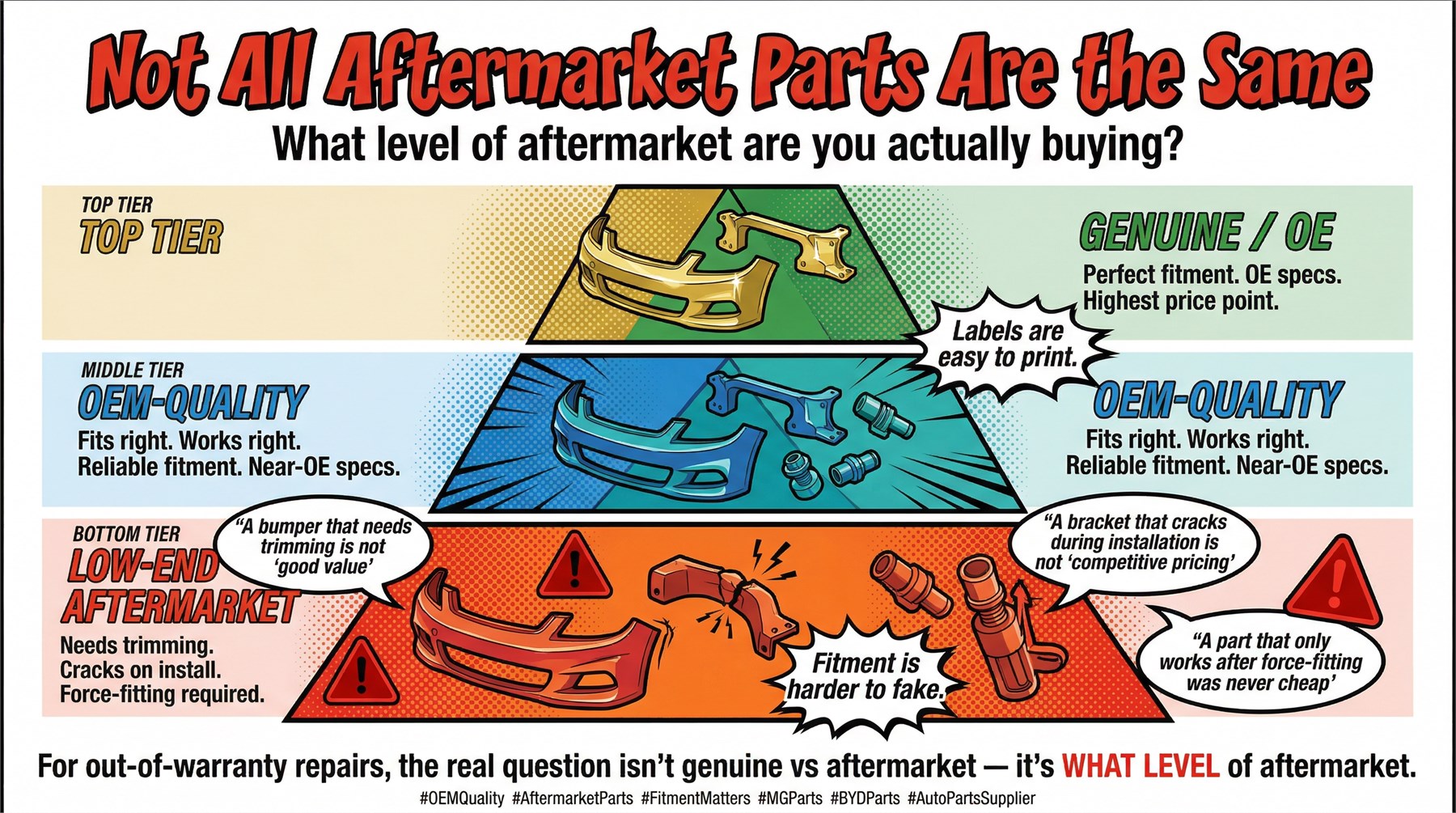
Labels are easy to print. That is exactly why they are not enough by themselves. Two parts can both be described as aftermarket and still behave very differently once they reach the workshop. One may install cleanly, align well, and hold finish. Another may need trimming, force fitting, or replacement after the first attempt.
The same problem appears when buyers assume that every low-priced item creates savings. If the part creates rework, labor waste, or customer delay, the cheaper invoice can turn into a more expensive job.
What Does Genuine Or OE Usually Mean?
Genuine or OE usually means the part is aligned with original-equipment supply. Buyers often choose it when they want the highest confidence level and are willing to pay more for it. That does not mean it is always the best answer for every repair job, but it does mean the buyer expects the strongest fitment confidence.
What Is OEM-Quality Aftermarket?
OEM-quality aftermarket is often the most practical middle lane. The part is not being sold as official genuine OE, but it is expected to fit correctly, function correctly, and sit close to original standards in the areas that matter to the repair. This is often the value position serious buyers care about most.
What Is Low-End Aftermarket And Why Does It Hurt Jobs?
Low-end aftermarket usually reveals itself through weak consistency. The part may need trimming, show poor alignment, crack under install stress, or create cosmetic mismatch. Buyers often feel the pain in body parts and brackets first, but the real damage happens in labor time and reputation, not just part cost.
| Level | Typical Strength | Main Risk |
|---|---|---|
| Genuine / OE | Highest fitment confidence | Highest cost |
| OEM-quality aftermarket | Strong value and reliable fitment | Needs supplier proof, not just label |
| Low-end aftermarket | Lowest invoice cost | Trim, rework, cracking, labor waste |
FAQ
Is genuine always the best choice?
Not always. It offers high confidence, but some repairs are better served by strong OEM-quality aftermarket value.
What does OEM-quality really mean?
It usually means the part is expected to fit and function close to OE standards without being sold as official genuine OE.
Why can low-end parts become expensive?
Because trimming, cracking, poor alignment, and rework increase total job cost.
What is the key screening question?
Ask what proof the supplier can give that the part fits right and works right, not just what label is printed on it.