Fact Gate
Review Dates For Time-Sensitive Claims
- Reviewed on
- 2026-05-05, against the public references named in this article where external facts are used.
- Next review due
- 2026-05-31, or sooner if freight, tariff, market availability or public-source conditions change.
- Maintenance rule
- Update or remove time-sensitive wording before reuse if the linked sources no longer support it.
Answer Card
Buyer Decision Summary
- Problem
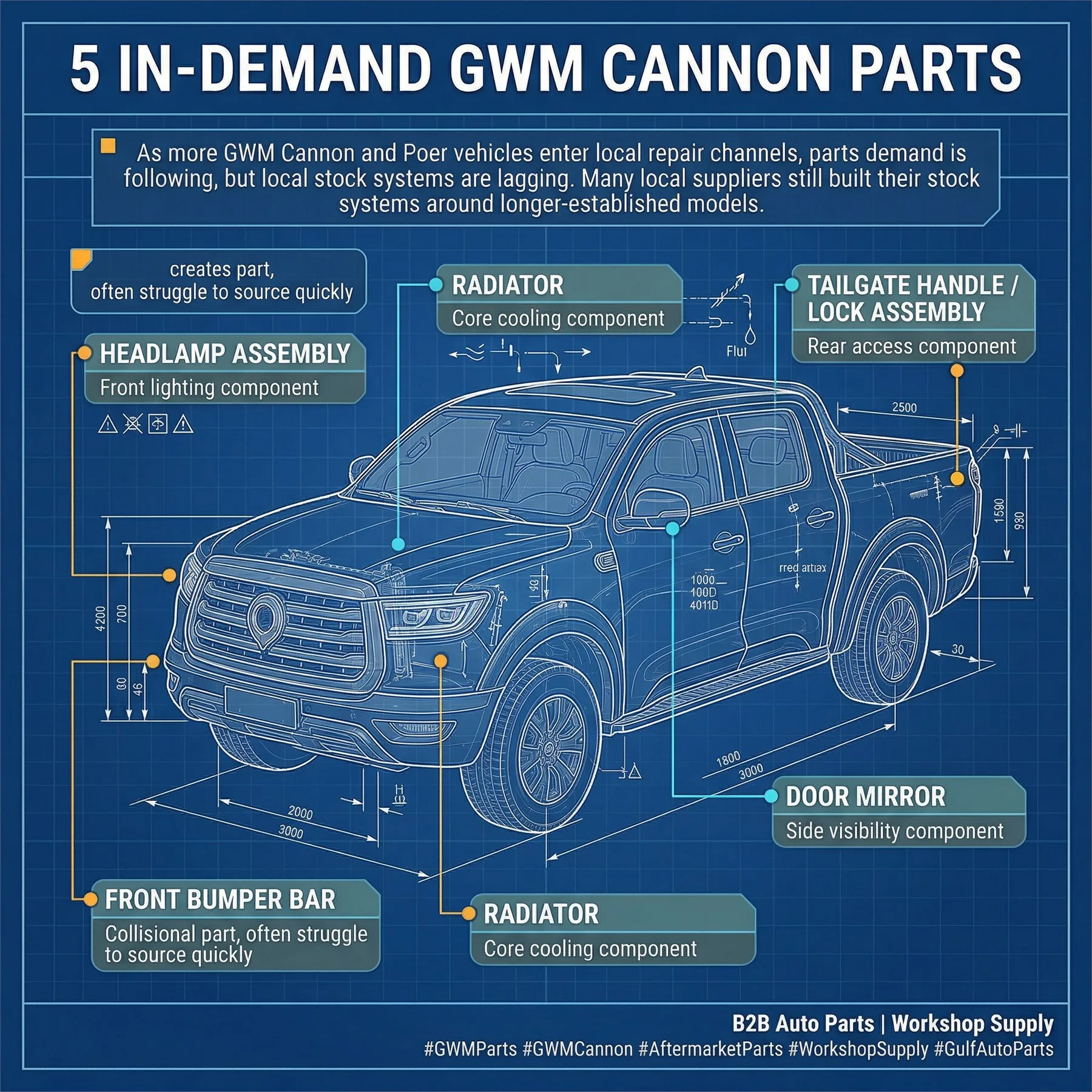
- Five GWM Cannon parts often become difficult first as workshop demand starts to rise: front bumper bar, headlamp assembly, radiator, door mirror, and tailgate handle or lock assembly.
- Best control
- Build a first basket around repeat service parts, then release visual or version-risk parts only with photo proof.
- Best buyer fit
- Global export buyers parts shops, workshops, distributors, and online sellers
- Brace support
- Jordan checks OE / VIN / old-part photos, confirms stock or source options, and routes mixed-order quotes to WhatsApp.
- Next step
- Send OE / VIN / photo on WhatsApp
What Is the GWM Cannon?
The GWM Cannon (also known as the GWM Poer in some markets) is a midsize pickup truck produced by Great Wall Motors. Launched in 2020 and expanded into export markets including Australia, South Africa, and the Middle East from 2021 onward, the Cannon combines a 2.0-litre turbo-diesel engine with a ladder-frame chassis and modern cabin features. In Gulf markets, it competes directly with the Toyota Hilux, Ford Ranger, and Mitsubishi L200 on price while carrying higher equipment levels. The Cannon’s sales growth in Saudi Arabia, Oman, and Australia has been sharp enough that workshops in those markets are now seeing regular service and collision demand — often before local parts networks have built full coverage.
How Big Is the Cannon Aftermarket Opportunity?
Great Wall Motors shipped over 7 million vehicles globally in 2025, with pickup trucks representing a significant share of export volume. The Cannon and its stablemate the Poer are the company’s flagship pickup platforms. In Australia, the Cannon ranked fourth among 4x4 pickups in 2024, trailing only the Toyota Hilux, Ford Ranger, and Isuzu D-Max. In the Middle East, GWM’s combined SUV and pickup sales grew by double digits year-on-year, with Saudi Arabia and Oman as the strongest markets.
This volume creates a predictable aftermarket curve. A pickup that records 5,000 annual units in a market will generate collision-part demand for roughly 8-12% of that fleet annually, and cooling-system demand for another 3-5%. Those percentages sound small until you realise that no local stock system was preparing for them 24 months ago.
Why Do These Parts Move First?
Early aftermarket demand usually clusters around the parts that fail or get damaged in the most ordinary ways. Collision items move because they are exposed. Lamps and mirrors move because they are vulnerable. Radiators matter because cooling demand becomes urgent, not optional, when a vehicle is off the road. For the GWM Cannon specifically, mechanic reports from Australian workshops have documented early-pattern failures including vacuum pump oil leaks, intercooler hose cracking, and fuel filter clamp loosening — issues that become visible around the 50,000 to 65,000 kilometre mark.
These failure patterns matter for importers because they signal which categories will generate repeat demand. A workshop that replaces one radiator because of heat stress will likely need another within the same fleet. A workshop that sources one headlamp after a minor collision will need the matching opposite-side unit before the quarter ends.
Which Five Parts Are Worth Tracking?
1. Front Bumper Bar
The front bumper bar is one of the earliest hard-to-source items because it sits at the center of common collision work and can vary by trim or sensor opening. The Cannon’s front bumper integrates fog lamp housings and, on higher trims, parking sensor cutouts. This means a bumper for a base-model Cannon may not fit a luxury trim without modification. Aftermarket suppliers often stock the most common variant first, leaving workshops with premium-trim customers waiting for special-order parts.
2. Headlamp Assembly
Headlamps combine visibility, fitment sensitivity, and cosmetic pressure. Workshops do not want a rough substitute here. The Cannon uses a projector-style headlamp with LED daytime running light strips on most trims. Replacement units must match not only the housing shape but also the inner reflector pattern and electrical connector. Mismatched headlamps can fail inspection or create beam-pattern complaints that cost the workshop repeat business.
3. Radiator
The radiator is a downtime part. When cooling demand appears, the buyer needs a usable answer quickly. The Cannon’s 2.0-litre turbo-diesel runs hot under load, and in Gulf climates with ambient temperatures regularly exceeding 40°C, cooling system stress is higher than in temperate markets. Radiator failures on turbo-diesel pickups typically cluster around the 80,000 to 120,000 kilometre range, but early leakage from hose connections or plastic tank seams can appear sooner in extreme heat.
4. Door Mirror
Mirrors are high-risk because they can vary by side, cover state, and functional detail. The Cannon uses both manual and power-folding mirrors depending on trim, and some markets receive mirrors with integrated turn signals. A left-hand mirror with power fold and signal is not interchangeable with a basic right-hand manual unit. Workshop delays multiply when a supplier ships the wrong variant and the correction takes two to three weeks.
5. Tailgate Handle or Lock Assembly
Rear access parts look small, but they create real customer friction when unavailable. The Cannon’s tailgate handle is a composite unit that includes the release mechanism and, on some variants, the backup camera housing. Lock assemblies can fail from dust ingress — a common issue in desert environments. Because these parts are low-value but high-friction, workshops often keep one or two in stock once they have identified the correct variant.
| Part | Why It Matters | Typical Sourcing Risk | Estimated Aftermarket Price Range (USD) |
|---|---|---|---|
| Front bumper bar | Common collision demand | Trim and opening differences | 180-320 |
| Headlamp assembly | Safety and cosmetic pressure | Fitment and side confusion | 90-180 |
| Radiator | Vehicle downtime risk | Urgency and stock lag | 120-240 |
| Door mirror | Side visibility and daily damage | Variant mismatch | 70-150 |
| Tailgate handle / lock | Practical customer use | Smaller items often overlooked | 40-90 |
OE vs. Aftermarket: What Works for the Cannon?
GWM operates a genuine parts network through authorised dealers, but coverage outside China is still expanding. In Australia, genuine Cannon parts are available through GWM dealers with typical lead times of 3-10 business days for stocked items and 2-4 weeks for non-stocked parts. Aftermarket options are growing but vary in quality.
| Source | Availability | Price Level | Best For |
|---|---|---|---|
| GWM Genuine (dealer) | Good in China; limited in Gulf | 100% baseline | Warranty repairs, exact fitment |
| OEM-grade aftermarket | Growing; depends on supplier | 60-75% of genuine | Collision repair, routine service |
| Generic aftermarket | Widely available | 40-55% of genuine | Budget repairs, older fleet units |
Why Do Local Suppliers Miss This Early?
Many stock systems were built around older model populations. That means the supplier’s warehouse logic may still prioritise older movement patterns rather than current repair demand. When a new model like the Cannon enters a market in volume, the mismatch between vehicle population and parts stock becomes visible within 12 to 18 months.
The second reason is catalog fragmentation. GWM has released multiple Cannon variants — single cab, double cab, 4x2, 4x4, and different trim levels — and not all suppliers have mapped part compatibility across those variants. A supplier who stocks a radiator for the 4x2 may not realise the 4x4 uses a slightly different core thickness until a workshop complains.
How to Verify Cannon Part Fitment Before Ordering
Ordering the wrong variant is the most expensive mistake a workshop can make with Chinese-brand parts. The return shipping cost often exceeds the part value. Here is a practical verification sequence:
- Confirm the build year and market. Australian-market Cannons differ from Middle East-market units in emission equipment and some trim details. A 2021 model may differ from a 2023 model in headlamp components.
- Photograph the existing part. Take clear images of the part number tag, mounting points, and electrical connectors. Send these to your supplier before requesting a quote.
- Ask for a cross-reference. A competent supplier should be able to map your requirement to at least one OE number or an aftermarket equivalent. If they cannot, they probably do not stock deep Cannon coverage.
- Request a sample or photo confirmation. For high-value items like bumpers or radiators, ask the supplier to photograph the actual unit before shipment. This catches trim-level mismatches early.
- Order side-specific items in pairs when possible. If you need a left headlamp today, you will probably need a right headlamp within the same quarter. Ordering both reduces shipping cost per unit and prevents a later mismatch if the supplier discontinues the line.
- Track which variants move in your market. Keep a simple log of build years, trim levels, and part numbers that worked. This becomes your own catalogue over time.
What About the Other Parts?
The five parts above are the earliest movers, but they are not the only ones. Brake pads, shock absorbers, intercooler hoses, and air filters all generate demand as Cannon fleets age. The key insight is that the first parts to become difficult are rarely the most expensive. They are the ones that combine high frequency, trim sensitivity, and low local stock — a combination that creates workshop friction before it creates importer opportunity.
Sources & Methodology
This article is based on publicly available mechanic reports, aftermarket catalog listings, and industry observation. Common failure patterns (vacuum pump leaks, intercooler hose cracking, fuel filter clamp issues) are documented in Australian mechanic videos and social media channels specialising in GWM vehicles. Price ranges are estimated from public aftermarket listings in Australia and the Middle East and do not represent Brace Auto Parts pricing. The 18-to-24 month aftermarket demand pattern is an industry-observed rule widely referenced in automotive aftermarket strategy. GWM genuine parts availability data is based on dealer and distributor websites in Australia and China. All operational recommendations are based on the author’s direct experience in Chinese auto parts export sourcing.
FAQ
Are these the only GWM Cannon parts that matter?
No, but they are among the earliest and clearest demand signals for workshop channels.
Why do mirrors matter so much?
They are exposed, side-specific, and often tied to trim detail, which raises mismatch risk.
Should buyers stock these locally?
If Cannon demand is growing in your market, these are good candidates for early stock planning or fast replenishment lanes.
What is the biggest mistake?
Assuming a supplier who supports older pickups automatically has deep Cannon coverage.
How do I know if my supplier actually stocks Cannon parts?
Ask for photos of the actual unit, OE cross-references, and variant-specific confirmation. A supplier with real stock will answer quickly. A supplier without it will delay or generalise.
Buyer Downloads
Use This Guide In A Real RFQ
RFQ Template
Copy This RFQ Format
Brand / model:
Year:
OE number:
VIN:
Old part photo:
Quantity:
Destination:
Need photo confirmation before shipment? Yes / No