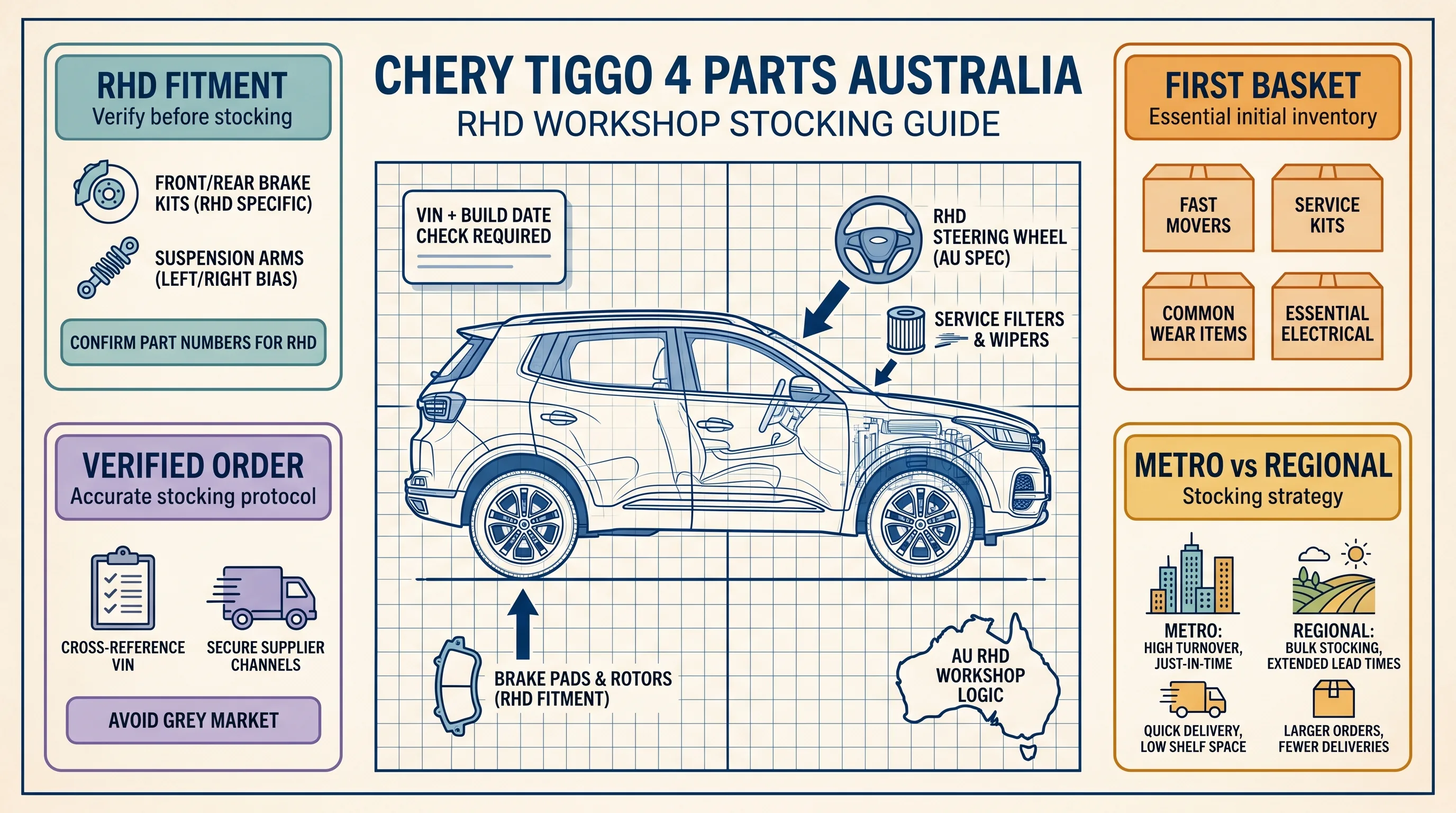
Answer Card
Buyer Decision Summary
- Problem
- Model-only sourcing can still create wrong-part, wrong-year, or wrong-version risk.
- Best control
- Build a first basket around repeat service parts, then release visual or version-risk parts only with photo proof.
- Best buyer fit
- Australia / RHD markets workshops and parts shops
- Brace support
- Jordan checks OE / VIN / old-part photos, confirms stock or source options, and routes mixed-order quotes to WhatsApp.
- Next step
- Send OE / VIN / photo on WhatsApp
Quick takeaway
- Stock the petrol Tiggo 4 as a narrow service-and-brake line first.
- Split applications by grade and wheel package, not just by model name.
- Keep hybrid, trim, electronics, and bulky crash parts on verified order.
- Use VIN, build date, wheel size, and sensor-content checks before release.
- Metro branches can lean harder on feeder stock; regional workshops need slightly deeper immediate coverage.
Definition: In this article, a controlled RHD stocking program means a narrow shelf file for confirmed Australian right-hand-drive petrol applications, backed by VIN, build date, grade, wheel package, and photo checks before brake, chassis, trim, electronic, or hybrid-linked parts are released.
Benchmark note: Unless otherwise stated, the stocking stances and metro-versus-regional guidance in this article are based on recent Brace order handling for Australian RHD workshop customers. They are practical working benchmarks, not universal market averages.
Why is Chery Tiggo 4 parts Australia a narrow but real stocking opportunity?
The Tiggo 4 is worth stocking in Australia, but only in a disciplined way. It is not a full-catalogue vehicle yet. It is a new-enough platform with real workshop visibility, local RHD relevance, and enough owner support behind it to create genuine demand for routine repair items.
Chery’s Australian model page shows the Tiggo 4 is sold locally in Urban and Ultimate grades and backed by a 7-year unlimited-kilometre warranty, 7-year capped price servicing, and 7-year roadside assistance. That matters because a supported, nationally marketed model is more likely to build an installed base that turns into independent service and repair work. Chery Australia model page
For an aftermarket buyer, though, the correct reading is restrained. A strong ownership package does not mean broad immediate parts turn. Early demand appears first in service items, wear items, and repair lines that save a booked workshop bay. It does not justify filling shelves with cosmetic trim, slow-turn electronics, or heavy crash parts.
The local grade structure also pushes buyers toward selective stocking. Chery lists a 17-inch and 18-inch split across grades on the Australian model page, which is enough on its own to warn against collapsing all brake and chassis demand into one generic model listing. Chery Australia model page
The right thesis is simple: this is a real RHD opportunity, but only if you stock anchors rather than pretending the market already needs full depth.
Why is this model harder to buy for right now?
The buying problem is not demand alone. The harder issue is identity, scope, and release accuracy. The Australian market saw the vehicle introduced as Tiggo 4 Pro in October 2024, then renamed to Tiggo 4 in April 2025. That rename creates search noise, catalogue duplication risk, and workshop confusion. ANCAP safety rating
ANCAP’s published scope also makes an important parts point: its rating applies to petrol variants in Australia and New Zealand, while hybrid variants are unrated. For parts buyers, that means the first gate is not “Tiggo 4 yes or no.” The first gate is “petrol or hybrid, and what exact local application are we looking at?”
The same rating page notes that the five-star result for Australian-sold Tiggo 4 Pro vehicles applies to examples built from November 01, 2024 after recall rectification, with scores of 88% adult occupant protection, 87% child occupant protection, 79% vulnerable road user protection, and 85% safety assist. Buyers should read that as a repair-documentation issue. Safety-system-linked parts, front-end components, and sensor-adjacent items need tighter build-date and variant control than the model name suggests. ANCAP safety rating
There is also a basic new-model problem. Workshops want quick answers. Catalogues for fresh Chinese-brand passenger vehicles can lag real VIN application, supersession, or local-grade detail. That creates scheduling pressure: a same-day brake job can be won or lost on one wheel-size assumption.
A counterpoint matters here. Being too cautious can also cost good work. If every Tiggo 4 enquiry is forced into long verification or indent ordering, the workshop loses straightforward service and brake jobs that could have been handled cleanly with a narrow, verified stock file.
What should workshops stock first, and what should stay feeder- or job-based?
Workshops should stock only the parts that rescue common booked work first. For Chery Tiggo 4 parts Australia, that means confirmed petrol service filters, routine maintenance kits, and wheel-size-aware brake lines before anything cosmetic, electronic, or bulky.
The local grade split is central. Chery’s Australian materials show Urban and Ultimate grades and a 17-inch versus 18-inch wheel split, while the official MY2026 specification sheet sets out wheel, tyre, suspension, powertrain, and equipment differences buyers need to respect. That is enough to justify separate stock logic for brake and some chassis applications. Chery Australia model page; official MY2026 specification sheet
A sensible first-stock list includes:
- Engine service filters for confirmed local petrol applications
- Cabin and intake service lines where fitment is stable
- Front brake pads for verified petrol variants
- Front rotors only where grade and wheel application are confirmed
- Rear brake consumables after local demand is visible
- Wiper lines only if application data is clean and stable
What should stay out of local shelf stock?
- Bumper covers and painted exterior trim
- Lamps with grade or sensor-content variation
- Camera, radar, and calibration-sensitive items
- Interior trim and switchgear
- Steering and suspension lines without proven application mapping
- Hybrid-specific components unless part numbers are confirmed
The rule is not “stock nothing unfamiliar.” The rule is “stock only what turns fast and survives a catalogue mistake.” That distinction keeps landed cost and obsolescence under control.
How should local stock, feeder stock, and job-based ordering be split?
The split should follow urgency, fitment stability, and packaging risk. Local stock exists to save today’s booked job. Feeder stock exists to support short-horizon replenishment. Job-based ordering exists for low-frequency, high-variation, or damage-prone lines.
Metro and regional logic should differ. Metro workshops can rely more on feeder depth because same-city replenishment is easier. Regional workshops need slightly more immediate stock in service and brake lines because missed fitment costs more time and customer goodwill.
| Workshop part family | Local stock | Feeder stock | Job-based only | Why this split works |
|---|---|---|---|---|
| Service filters and routine maintenance kits | Yes | Yes | No | Fast repeat demand, low packaging risk, low obsolescence |
| Front brake pads for confirmed petrol applications | Yes | Yes | No | High workshop urgency and repeatable demand |
| Rotors and wheel-size-linked brake lines | Selectively | Yes | No | Grade split creates real fitment risk, but demand is still practical |
| Struts, hubs, bearings, arms, and related chassis wear items | No | Yes | Sometimes | Heavier landed cost and lower turn, but still legitimate feeder lines |
| Lamps, mirrors, bumper hardware, trim, and sensor brackets | No | Limited | Yes | High variation, higher return risk, and fragile packaging |
| ADAS-adjacent front-end items | No | Limited | Yes | Verification and calibration exposure are too high for open shelf stock |
| Hybrid-specific parts | No | No | Yes | Separate technical path until local mapping is confirmed |
This table is the real buying logic. It is not about how many SKUs exist on paper. It is about what the workshop needs within the booking window.
What pre-order verification and fitment controls matter most?
The most important controls are variant separation and release discipline. If a buyer skips VIN, build date, grade, and wheel-package checks, the savings from shallow stock disappear in returns, dead shelf stock, and workshop downtime.
For this model, the minimum verification file should include:
- VIN or registration decode
- Petrol versus hybrid confirmation
- Tiggo 4 Pro versus renamed Tiggo 4 alias check
- Build date where safety-system or front-end parts are involved
- Urban versus Ultimate grade
- Wheel and tyre package confirmation
- Left-hand versus right-hand application and sensor content
- Photo or measurement match for brake and chassis items
The official MY2026 specification sheet is valuable here because it confirms that wheel, tyre, suspension, and equipment details are not trivial catalogue extras; they affect parts choice directly. Even when two vehicles share the same broad model name, a wheel-size or equipment mismatch can break the release. official MY2026 specification sheet
RHD confirmation also matters more than buyers admit. Australian workshops do not need a stock file contaminated by non-local applications, parallel catalogue entries, or unverified cross-border data. Keep the release sheet explicitly RHD and local-market focused.
For insurer and fleet-style work, the control standard should be higher. Save the VIN capture, old-part image if available, and the application note used to release the part. That documentation becomes the difference between a contained return and an argument.
What does a low-risk pilot basket look like?
A low-risk pilot basket should be designed to protect booked service and brake work, not to imitate a dealer catalogue. If the opening buy cannot save common workshop time, it is the wrong basket.
A workable pilot basket for Chery Tiggo 4 parts Australia looks like this:
- Petrol engine oil filters
- Air filters
- Cabin filters
- Routine service consumables tied to confirmed service kits
- Front brake pad sets for verified petrol applications
- Front rotors only where wheel-size mapping is secure
- Rear brake consumables once local application is confirmed
- Wiper lines only if fitment data is stable across local grades
What stays out of the pilot basket is just as important:
- Body panels
- Colour-sensitive trim
- Headlamps and sensor-heavy lighting lines
- Steering racks
- Air-conditioning compressors
- Infotainment or switch modules
- Cameras, radar units, and bracket sets
- Any hybrid-specific line without local confirmation
This is also where landed cost discipline shows up. Bulky or fragile parts tie up cash, cost more to move, and generate uglier returns when the fitment file is still young. Service and brake anchors are lighter, clearer, and more repeatable.
A buyer who wants one simple test can use this: if the item misses fitment, does it create a minor stock correction or a painful freight-and-downtime event? The pilot basket should be built around the first category only.
Where does the logic fail, what should buyers ask suppliers, and where does Brace Auto Parts fit?
The logic fails when buyers assume that “new and popular” means “safe to stock broadly.” It also fails when suppliers cannot prove local application discipline for the renamed model, the petrol-versus-hybrid split, or the grade and wheel-package differences that drive repair accuracy.
Ask suppliers six plain questions before expanding the range:
- Can you separate Tiggo 4 Pro and Tiggo 4 naming without duplicating the wrong application?
- Can you ring-fence hybrid demand from petrol demand?
- Can you map wheel-size-sensitive brake lines to local grades?
- Can you show application evidence, not just a generic catalogue line?
- Can you flag supersessions and batch traceability?
- Can you support metro versus regional replenishment without forcing full local stocking?
If those answers are weak, the supplier is not ready for this model.
For buyers screening supply options, Brace Auto Parts may be a suitable option only if it is aligned with these requirements: RHD-first application control, narrow anchor-SKU stocking, clear feeder support, and disciplined release checks. It is one example of a supplier built around this workflow, not a reason to loosen the workflow itself.
FAQ
Should Tiggo 4 Pro and Tiggo 4 sit under one stock file?
They can share a controlled application file for confirmed petrol equivalents, but the alias must stay visible. The April 2025 rename creates search and return risk if old and new naming are merged carelessly.
Should workshops stock hybrid parts with petrol parts?
No. Keep hybrid demand quarantined until part numbers and local application are confirmed. ANCAP’s published rating scope is petrol only, which is enough reason to separate the workflow.
Do Urban and Ultimate need separate brake handling?
Yes, where wheel-size-linked brake parts are involved. The local 17-inch and 18-inch grade split is a direct signal to verify before stocking or release.
Are body panels a good early stocking category?
No, not for a first-wave program. They are bulky, damage-prone, colour-sensitive, and less forgiving when the application file is still maturing.
How should regional workshops adjust the plan?
Carry slightly deeper service and core brake coverage than a metro site. Regional replenishment gaps cost more workshop time, so the local shelf has to do a bit more.
What is the minimum release pack for a non-service item?
VIN, grade, petrol-versus-hybrid confirmation, build date if relevant, wheel package where applicable, and at least one image or dimensional check for the outgoing part.
Are safety-system parts suitable feeder stock?
Only in a limited, well-documented way. Front-end items tied to cameras, sensors, or calibration exposure are better handled as verified-order lines unless the application data is exceptionally clean.
Operational verdict
For Chery Tiggo 4 parts Australia, the defensible move is a controlled RHD petrol program: stock service kits and confirmed brake anchors, split wheel-size-sensitive items by local grade, and keep electronics, cosmetic lines, and hybrid demand on verified order. Buyers who skip VIN, build-date, and application controls will create wrong-stock exposure faster than they create useful availability.
Public references
- Chery Australia Tiggo 4 model page
- Chery Australia MY2026 Tiggo 4 specification sheet
- ANCAP Chery Tiggo 4 Pro safety rating
Buyer Downloads
Use This Guide In A Real RFQ
RFQ Template
Copy This RFQ Format
Brand / model:
Year:
OE number:
VIN:
Old part photo:
Quantity:
Destination:
Need photo confirmation before shipment? Yes / No