Answer Card
Buyer Decision Summary
- Problem
- Model-only sourcing can still create wrong-part, wrong-year, or wrong-version risk.
- Best control
- Build a first basket around repeat service parts, then release visual or version-risk parts only with photo proof.
- Best buyer fit
- GCC / Middle East workshops and parts shops
- Brace support
- Jordan checks OE / VIN / old-part photos, confirms stock or source options, and routes mixed-order quotes to WhatsApp.
- Next step
- Send OE / VIN / photo on WhatsApp
Quick takeaway
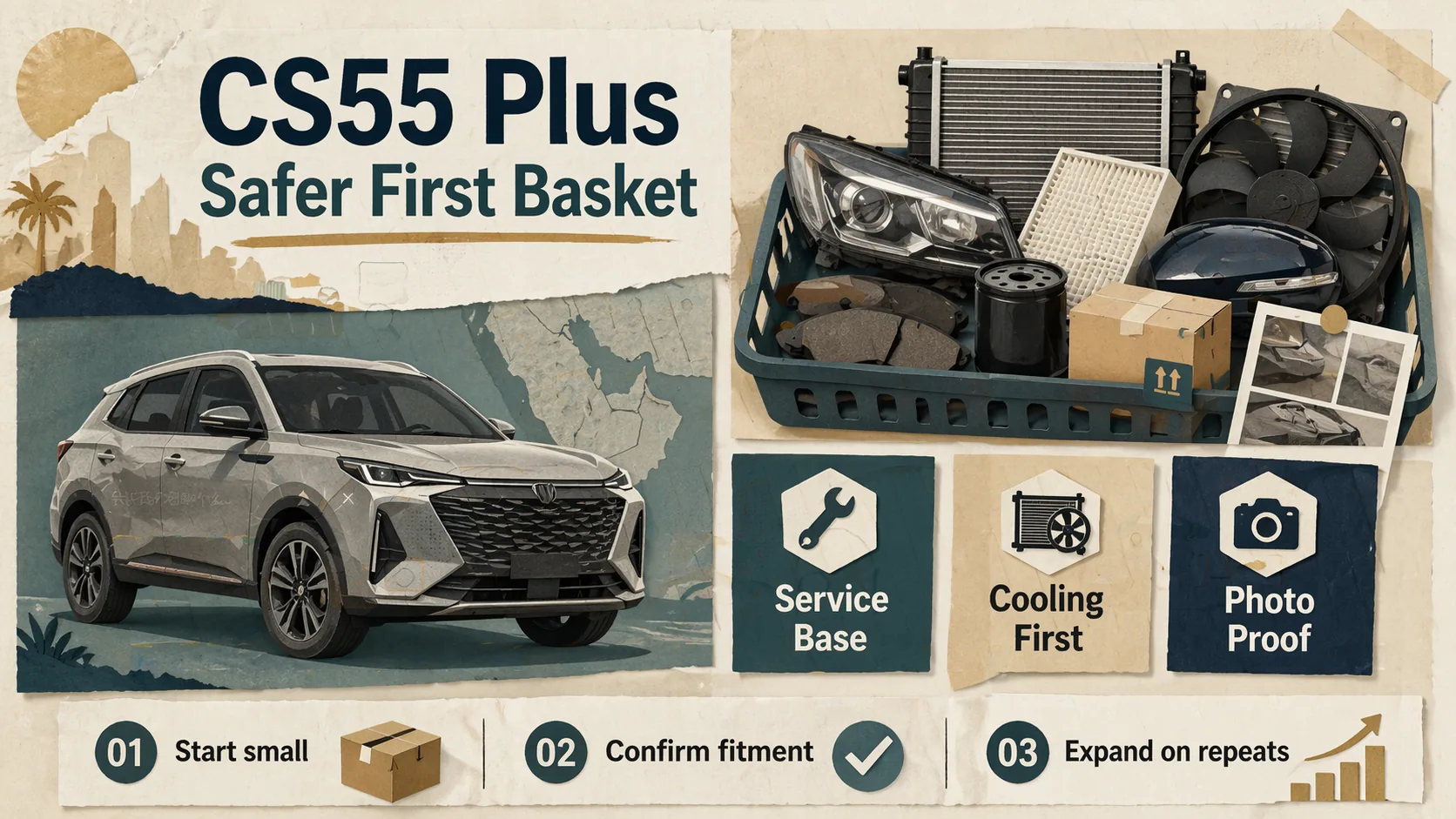
Start with a controlled 15-line basket, then expand based on real turnover. Visible, side-specific, and connector-sensitive lines should stay under confirm-before-release rules until the second cycle proves consistency.
Benchmark note: The 15-line structure is a Brace planning reference from Brace Auto Parts sourcing/order-handling work. It is a starting framework, not a fixed universal formula.
What is a first-stock basket in practical terms?
It is the minimum set of lines kept close during the first 60-90 days of a new model program. Its purpose is to protect daily bay flow while limiting fitment and shelf-risk exposure.
Why does CS55 Plus need a controlled start?
CS55 Plus demand can look straightforward, but year/trim/market/front-end differences still affect lamps, mirror assemblies, cooling mounts, and some electrical details.
Which lines belong in the first basket?
| Layer | Parts to include | Suggested count | Release logic |
|---|---|---|---|
| Service/wear | Filters, pads, routine wear lines | 5 | Small local depth |
| Cooling/A-C | Radiator, condenser, fan, hose | 4 | Prioritize heat-related repeats |
| Front-end repair | Headlamp, grille, supports | 3 | Photo-confirm key details |
| Confirm-before-release | Mirror, switch, garnish | 3 | VIN/side/photo proof required |
How should workshops test the first 90 days?
- Build from the 15-line structure; avoid broad speculative adds.
- Mark visible/side-specific/connector-sensitive lines as confirm-before-release.
- Require old-part photos on high-friction lines.
- Track line turnover and friction events through day 60.
- Keep bulky panels job-based until repeat jobs appear.
- Expand only after reviewing wrong-side, wrong-variant, and delay patterns.
What should buyers measure in the first 30 days?
| Metric | Healthy pilot signal | Warning sign |
|---|---|---|
| Fitment questioning | VIN/trim/side/photo asked on risky lines | Model-name-only quoting |
| Stock split clarity | Ready and sourcing separated | One blended availability claim |
| Proof discipline | Real photos on risky lines | Reused generic images |
| Dispatch communication | Packing/shortage updates pre-shipment | Issues explained after shipment |
| Claims response | Initial ownership within 48h | No owner path by 72h |
What should buyers ask before release?
- Which lines in this basket are variant-sensitive?
- Which items require old-part photos before dispatch?
- Which lines are truly ready stock today?
- What is the claims path for wrong-side or damaged arrivals?
Common questions
Should CS55 Plus lamps be stocked early?
Only after connector/mounting consistency is proven across repeat jobs.
Are cooling lines a priority in Gulf markets?
Yes, but exact radiator/condenser/fan variants still need confirmation.
Can genuine and OEM-quality aftermarket lines appear in one quote?
Yes, if quality level is clearly labeled line by line.
Should bulky panels be included in the first basket?
Usually no; keep them job-based until repeat demand is documented.
Is 15 lines always the right number?
Not always; treat it as a control template and adjust by local turnover.
Operational verdict
For CS55 Plus, disciplined first-basket control beats broad early stocking. Use a narrow, auditable start, confirm risky lines before release, and let real repeat demand decide what to scale next.
Public references
Buyer Downloads
Use This Guide In A Real RFQ
RFQ Template
Copy This RFQ Format
Brand / model:
Year:
OE number:
VIN:
Old part photo:
Quantity:
Destination:
Need photo confirmation before shipment? Yes / No