Answer Card
Buyer Decision Summary
- Problem
- Model-only sourcing can still create wrong-part, wrong-year, or wrong-version risk.
- Best control
- Build a first basket around repeat service parts, then release visual or version-risk parts only with photo proof.
- Best buyer fit
- GCC / Middle East workshops and parts shops
- Brace support
- Jordan checks OE / VIN / old-part photos, confirms stock or source options, and routes mixed-order quotes to WhatsApp.
- Next step
- Send OE / VIN / photo on WhatsApp
Quick takeaway
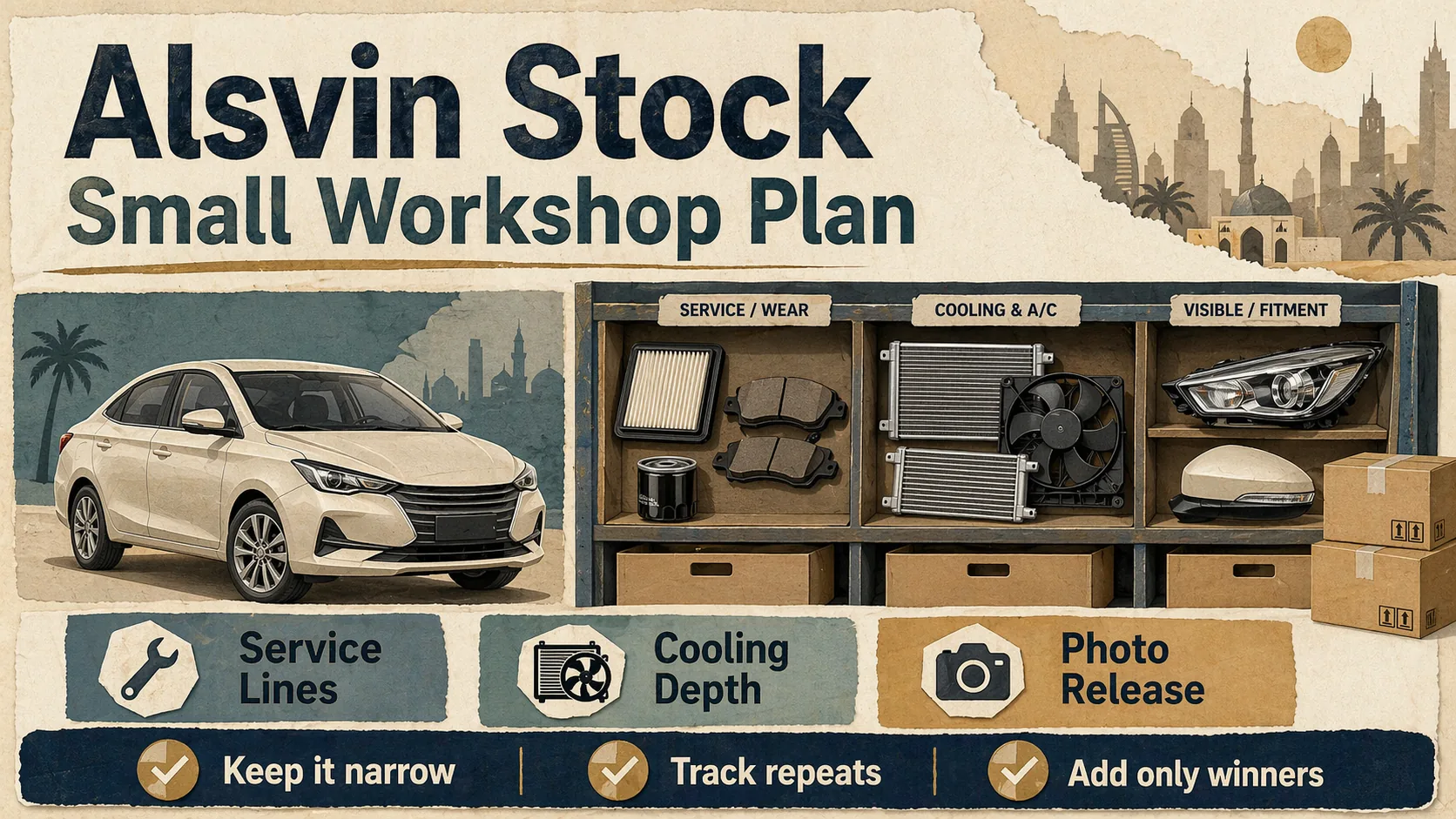
For Alsvin, the safest early strategy is to stock for workflow, not for catalog completeness. Keep fast-moving service lines close, add cooling depth only after repeat demand appears, and hold visual-risk parts under photo-backed confirmation until fitment evidence becomes stable.
Benchmark note: The 3-box framework comes from Brace Auto Parts export handling records. It is a practical control method, not a universal stocking rule.
What does shelf control mean for a small workshop?
Shelf control means protecting daily bay flow with compact repeat lines, while delaying bulky or cosmetic lines until local demand proves they are worth the space and cash.
Why does Alsvin need this kind of structure?
The business objective is stable repair throughput, not a complete-looking first basket. A wide opening order can feel efficient but often hides slow-moving visual stock and weak confirmation discipline.
Which lines belong in each box?
| Box | Parts focus | Stock stance | Main reason |
|---|---|---|---|
| Box A | Filters, brake pads, small wear | Small local depth | Supports daily repeat flow |
| Box B | Radiator, condenser, fan, hose | Add after repeat demand | Heat-related job stability |
| Box C | Lamp, bumper, mirror, trim | Confirm-before-release | Variant and cosmetic risk |
| Job-based | Large panels, slow garnish | Per-order only | Space and handling exposure |
How should workshops run the first 90-day test?
- Start with Box A as the operating base and avoid early broad adds.
- Bring in Box B when cooling jobs begin repeating in real numbers.
- Keep Box C under confirm-before-release by default.
- Require VIN/old-part photos on side-sensitive or visible lines.
- Track the 10-15 lines that actually turn by day 60.
- Expand only where turnover and fitment outcomes stay clean.
What should buyers measure in the first 30 days?
| Metric | Sign the process is working | Sign to pause |
|---|---|---|
| Turnover pattern | Service/cooling lines repeat | Cosmetic lines stay idle |
| Fitment proof | Photos used on visible-risk lines | Text-only quoting |
| Stock transparency | Ready vs sourcing clearly split | "Available" applied to all lines |
| Damage control | Fragile parts packed with proof | Packing discussed after issue |
| Claims ownership | First response within 48h | No ownership path by 72h |
Common questions
Should small workshops stock Alsvin body panels early?
Usually no. Keep them job-based until repeat accident demand is clearly visible.
Which Alsvin lines are safest to hold locally?
Service, wear, and proven cooling lines are usually the strongest starting group.
Why should cooling get early attention in Gulf markets?
Heat quickly exposes weak cooling coverage and increases comeback risk.
Is the 3-box model fixed for every workshop?
No. It is a control template and should be adjusted using turnover evidence.
How many lines should a small shop monitor first?
A focused 10-15 line tracking set is usually enough for early decisions.
Operational verdict
Alsvin can be a reliable small-workshop line when stock is managed narrowly and expanded by evidence. Use the 3-box structure as your operating control, and scale only from repeat turnover.
Public references
Buyer Downloads
Use This Guide In A Real RFQ
RFQ Template
Copy This RFQ Format
Brand / model:
Year:
OE number:
VIN:
Old part photo:
Quantity:
Destination:
Need photo confirmation before shipment? Yes / No